Golden Corona: The Science Behind Spain's Unique Eclipse
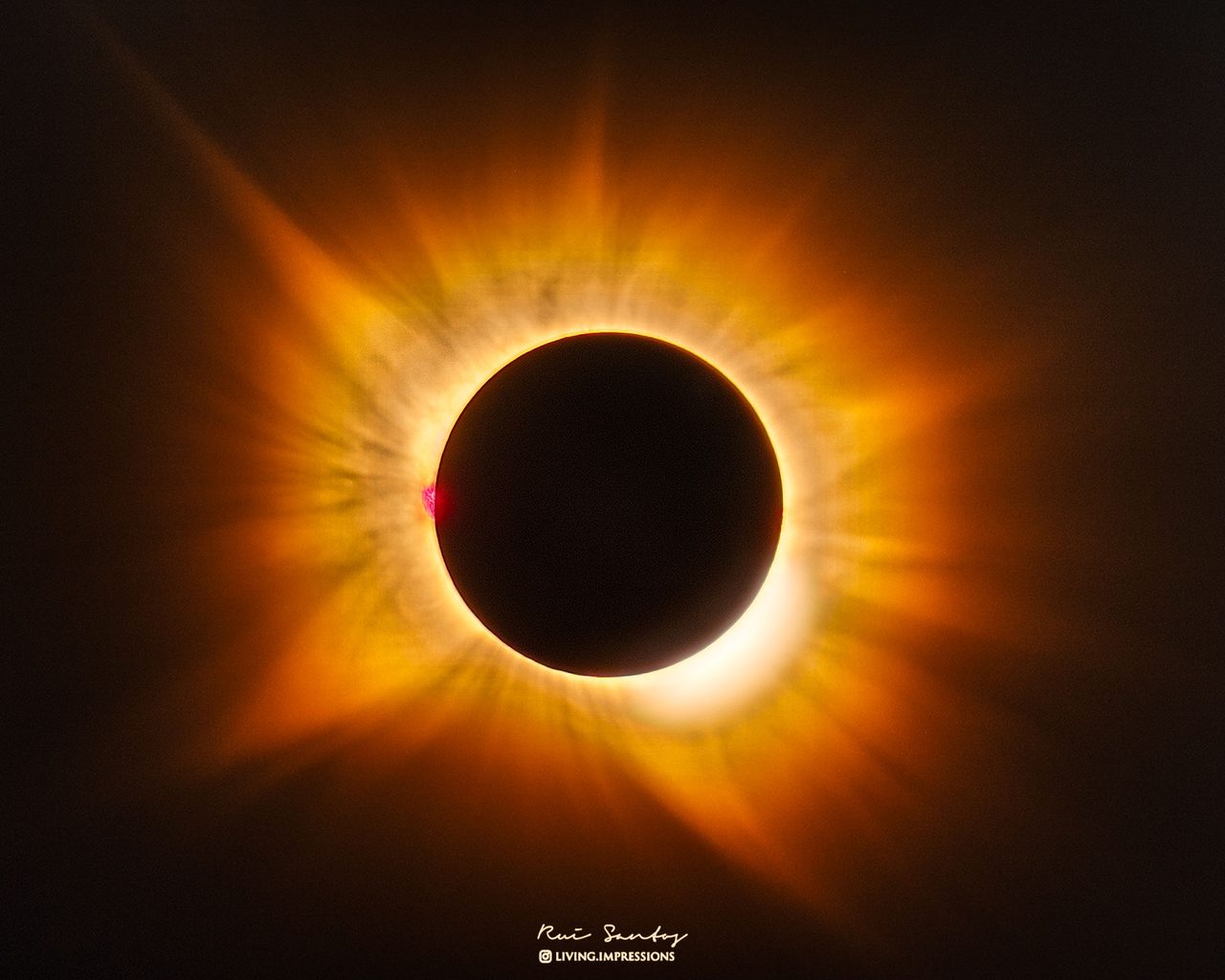
A rare golden solar corona was observed during a total eclipse in Spain, offering insights into atmospheric effects and solar phenomena.
The image captures a rare golden-hued solar corona during a total eclipse, observed from Benavente, Spain. Typically, the solar corona, the Sun's outer atmosphere, appears white. However, this eclipse presented a golden corona due to the Sun's position near the horizon and atmospheric conditions. As the Sun set, its light traversed a thicker layer of Earth's atmosphere, scattering blue wavelengths and leaving a warm, golden glow. Additionally, smoke from nearby forest fires further filtered the light, enhancing the golden appearance.
Atmospheric Influence on Astronomical Observations
The unusual golden corona observed during the eclipse highlights the significant role Earth's atmosphere plays in astronomical phenomena. The scattering of light, known as Rayleigh scattering, is responsible for the sky's blue colour and the reddening of sunsets. During this eclipse, similar scattering effects, combined with particulate matter from smoke, altered the corona's appearance. Understanding these interactions aids astronomers in interpreting observations, especially those involving celestial events seen through Earth's atmospheric lens.
Eclipse Observations and Orbital Mechanics
Total solar eclipses are rare events, governed by the precise alignment of the Sun, Moon, and Earth. The next opportunity to witness such an event can be found using the Orbital Radar pass predictor, which provides details on upcoming eclipses and other celestial events. Observers should consider atmospheric conditions, such as air quality and weather, which can significantly influence the visual experience of an eclipse.
Frequently Asked Questions
Why did the solar corona appear golden during the eclipse?
What is atmospheric scattering?
📎 Cite this article
Orbital Radar Newsroom. (2026). Golden Corona: The Science Behind Spain's Unique Eclipse. Orbital Radar. https://orbitalradar.com/blog/cosmic-gallery-2026-08-17"Golden Corona: The Science Behind Spain's Unique Eclipse." Orbital Radar, 18 August 2026, https://orbitalradar.com/blog/cosmic-gallery-2026-08-17.@misc{orbitalradar_cosmic_gallery_2026_08_17,
title = {Golden Corona: The Science Behind Spain's Unique Eclipse},
author = {{Orbital Radar}},
year = {2026},
howpublished = {\url{https://orbitalradar.com/blog/cosmic-gallery-2026-08-17}}
}