Witnessing the Dance of Shadows: A Solar Eclipse from Above
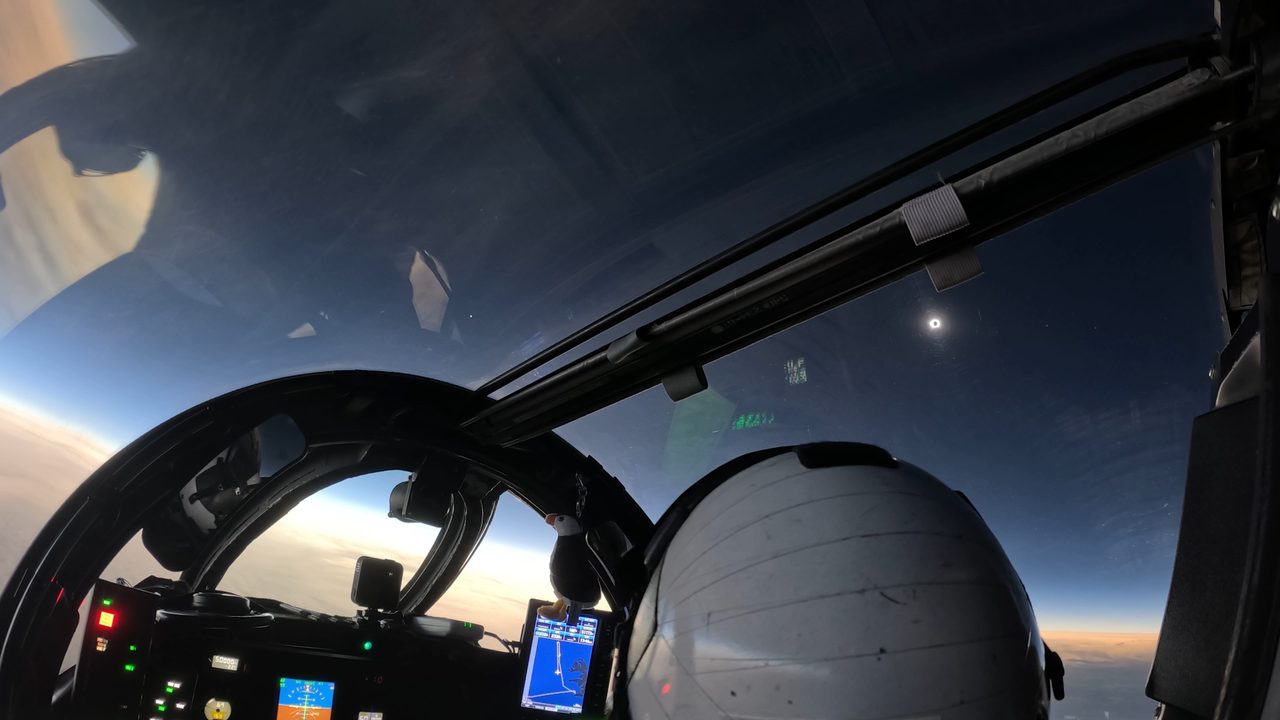
NASA's WB-57F aircraft captures a solar eclipse from 50,000 feet, offering a unique view of the Sun's corona and planets in the shadowed sky.
On August 12, NASA's WB-57F high altitude research aircraft soared above the North Atlantic to capture a solar eclipse from an unparalleled vantage point. Flying at 50,000 feet, the aircraft followed the path of totality, where the Moon completely obscures the Sun, casting a shadow on Earth. This altitude allowed the onboard suite of high-resolution cameras to bypass atmospheric disturbances such as clouds and water vapour, providing a clear view of the solar corona—the Sun's outer atmosphere visible only during an eclipse. The image captures Venus shining brightly to the left of the eclipsed Sun, while Jupiter and Mercury are faintly visible to the right, offering a celestial spectacle against the darkened sky.
The Science Behind Solar Eclipses
Solar eclipses occur when the Moon passes directly between the Sun and Earth, casting a shadow on our planet. This alignment is possible because the Moon's orbit around Earth is tilted relative to Earth's orbit around the Sun, allowing the three bodies to line up perfectly at certain times. The path of totality is a narrow track where observers can experience the full eclipse, while those outside this path see only a partial eclipse. The precise prediction of this path is a testament to our understanding of orbital mechanics, a field that also informs satellite deployment and tracking. For those interested in observing future eclipses, the Orbital Radar pass predictor can help identify optimal viewing locations and times.
Observing Tips and Tools
Experiencing a solar eclipse is a rare opportunity that requires careful planning. Observers should use proper eye protection, such as eclipse glasses or a solar filter, to safely view the Sun. For those unable to witness the event in person, platforms like NASA's live streams provide real-time coverage from various locations. Additionally, the Satellite Eye tool on Orbital Radar offers live satellite imagery, which can enhance understanding of how these celestial events are observed from space.
Frequently Asked Questions
What is a total solar eclipse?
Why observe a solar eclipse from an aircraft?
📎 Cite this article
Orbital Radar Newsroom. (2026). Witnessing the Dance of Shadows: A Solar Eclipse from Above. Orbital Radar. https://orbitalradar.com/blog/cosmic-gallery-2026-09-05"Witnessing the Dance of Shadows: A Solar Eclipse from Above." Orbital Radar, 6 September 2026, https://orbitalradar.com/blog/cosmic-gallery-2026-09-05.@misc{orbitalradar_cosmic_gallery_2026_09_05,
title = {Witnessing the Dance of Shadows: A Solar Eclipse from Above},
author = {{Orbital Radar}},
year = {2026},
howpublished = {\url{https://orbitalradar.com/blog/cosmic-gallery-2026-09-05}}
}