The night shift begins: sunset inside Paranal’s refuge
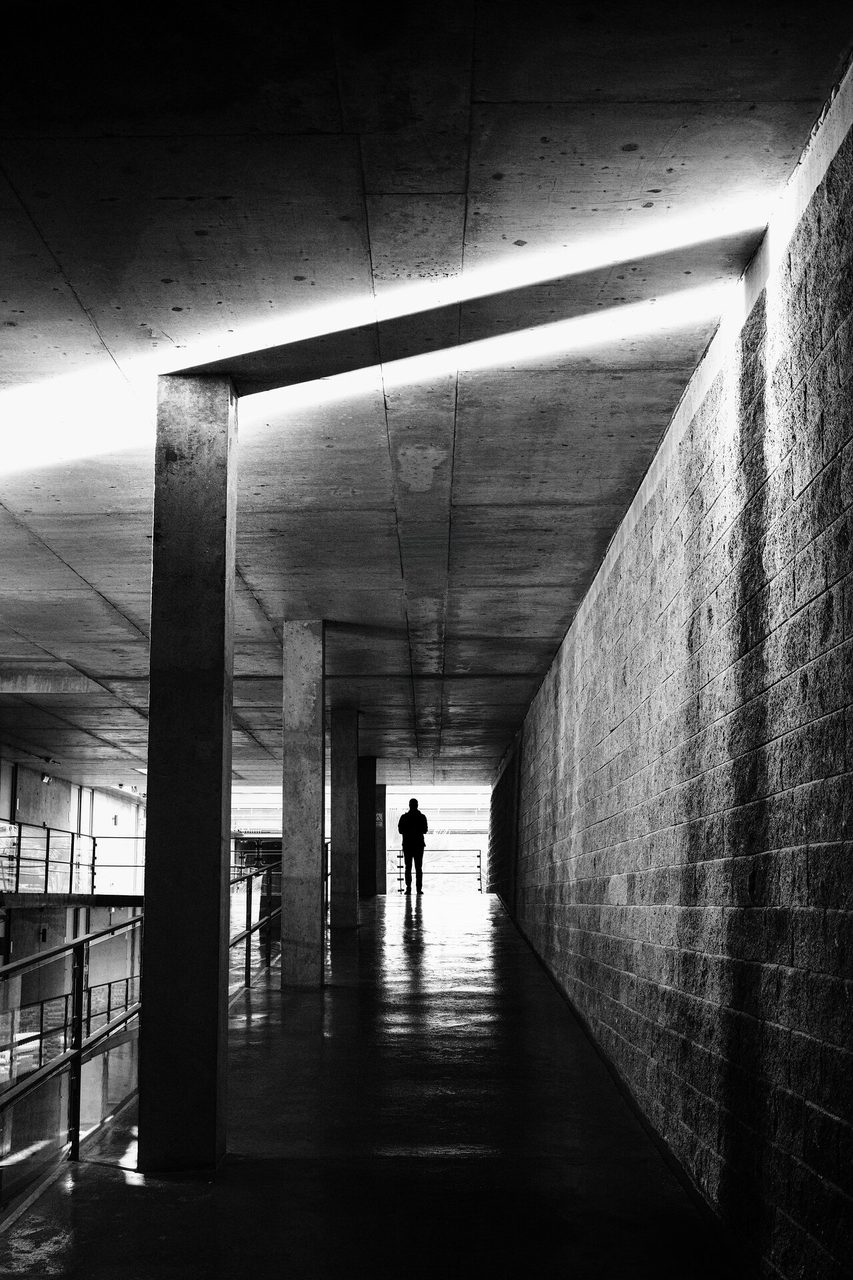
Sunlight cuts across a corridor at Paranal’s Residencia as astronomers prepare for work: a quiet portrait of the people behind a night of observing.
| Active satellites | 16,750 |
| Catalogued objects | 32,102 |
| Starlink active | 9,589 |
The last sunlight cuts through a corridor at ESO’s Paranal Observatory in Chile, casting lines of light and shadow across the Residencia’s concrete interior. At the far end of a ramp, a solitary figure stands in the light: a human presence at the threshold between daytime rest and night-time observing.
ESO staff astronomer Luca Sbordone noticed the scene while returning from dinner before heading to the telescopes. Recognising that the shadow pattern would last only a few minutes, he fetched his camera and asked a colleague to stand in the light. The fleeting geometry reflects the Sun’s changing apparent position as Earth rotates.
Built partly below ground, the Residencia shelters observatory staff from the remote Atacama Desert environment. A 35-metre-wide dome and several skylights bring natural daylight into its central spaces. Here, architecture makes room for sunlight while the working day is organised around its disappearance.
A working night beneath an occupied sky
Darkness opens the observing window for many astronomical targets, but the sky above an observatory is also a working environment for spacecraft. Orbital Radar tracking data lists 16,750 active satellites in orbit as of 29 November 2026. Satellites reflecting sunlight can cross telescope fields, making their changing positions relevant to ground-based observing.
Orbital Radar tracking data lists 9,589 operational Starlink satellites as of 29 November 2026. That orbital population offers a wider context for this quiet terrestrial scene: astronomers study distant objects through a sky shared with nearby technology.
For readers planning their own night outside, Orbital Radar’s Pass Predictor helps identify visible satellite passes. The photograph itself stays firmly indoors, showing the people and shelter that make long nights at Paranal possible.
Frequently Asked Questions
What does the photograph of Paranal’s Residencia show?
How does daylight enter the Paranal Residencia?
Cite this article
Pick a style, then copy it or download it for your reference manager.Orbital Radar. (2026, November 29). The night shift begins: sunset inside Paranal’s refuge. Retrieved November 29, 2026, from https://orbitalradar.com/blog/cosmic-gallery-2026-11-29
“The night shift begins: sunset inside Paranal’s refuge.” Orbital Radar, 29 Nov. 2026, orbitalradar.com/blog/cosmic-gallery-2026-11-29. Accessed 29 Nov. 2026.
Orbital Radar (2026) The night shift begins: sunset inside Paranal’s refuge. Available at: https://orbitalradar.com/blog/cosmic-gallery-2026-11-29 (Accessed: 29 November 2026).
Orbital Radar. “The night shift begins: sunset inside Paranal’s refuge.” Last modified November 29, 2026. https://orbitalradar.com/blog/cosmic-gallery-2026-11-29.
@misc{orbitalradar_blog_cosmic_gallery_2026_11_29,
  author       = {{Orbital Radar}},
  title        = {The night shift begins: sunset inside Paranal’s refuge},
  year         = {2026},
  month        = nov,
  howpublished = {\url{https://orbitalradar.com/blog/cosmic-gallery-2026-11-29}},
  url          = {https://orbitalradar.com/blog/cosmic-gallery-2026-11-29},
  urldate      = {2026-11-29},
  note         = {Accessed 2026-11-29}
}
TY - ELEC AU - Orbital Radar, TI - The night shift begins: sunset inside Paranal’s refuge PY - 2026 DA - 2026/11/29 PB - Orbital Radar UR - https://orbitalradar.com/blog/cosmic-gallery-2026-11-29 Y2 - 2026/11/29 LA - en ER -
Live figures change, so keep the date you accessed the page. How to cite Orbital Radar