Webb’s Red Spider Nebula reveals bubbles and a hidden jet
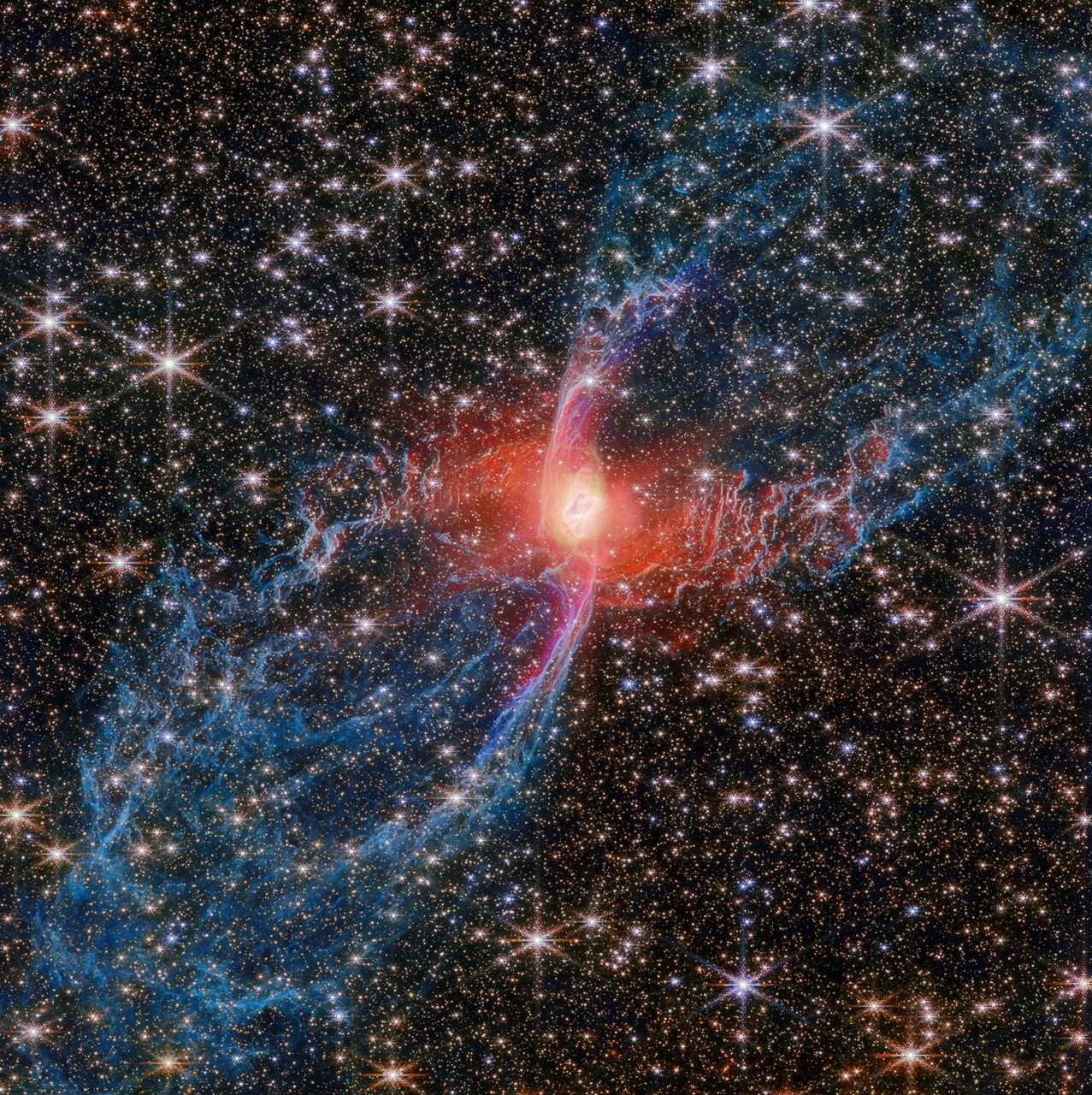
Webb reveals the Red Spider Nebula’s bubble-like lobes and a jet traced by glowing iron, exposing how a dying star reshapes the gas around it.
| Active satellites | 16,752 |
| Catalogued objects | 32,120 |
| Starlink active | 9,646 |
The Red Spider Nebula’s outstretched ‘legs’ are closed, bubble-like lobes, each extending about 3 light-years, newly revealed in full by the James Webb Space Telescope. Against a backdrop of thousands of stars, this view of NGC 6537 turns a spider-like silhouette into evidence of a dying star’s outflows.
Webb’s Near-Infrared Camera (NIRCam) traces molecular hydrogen in the lobes, shown here in blue. An elongated purple ‘S’ follows ionised iron (iron atoms stripped of electrons), marking where a fast-moving jet has struck material previously shed by the central star. Outflowing gas has inflated the larger bubbles over thousands of years.
The central star holds another clue. Faint and blue in optical images, it appears red to NIRCam because Webb detects a surrounding shroud of hot dust. That dust likely forms a disc; a hidden companion star could help explain the nebula’s narrow waist and broad outflows, although only one star is visible.
A brief stellar phase, studied from space
A planetary nebula is a glowing shell shed by an ageing star, not a birthplace for planets. After a star like the Sun expands into a red giant and loses its outer layers, ultraviolet light from its exposed core ionises the escaping gas. This luminous phase lasts only a few tens of thousands of years.
The observations belong to Webb programme 4571, part of a joint Chandra–Webb investigation into how stellar jets shape bipolar nebulae (nebulae with opposing lobes). Closer to Earth, Orbital Radar tracking data records 16,752 active satellites as of November 2026—a separate population from the distant stellar structures astronomical observatories investigate.
Orbital Radar’s live catalogue contains 32,120 tracked objects, including debris, as of November 2026. For readers moving between astronomical imagery and spacecraft tracking, the Orbital Radar Glossary explains the terminology used across spaceflight, while this image illustrates how different wavelengths reveal different physical processes.
Frequently Asked Questions
What does Webb’s Red Spider Nebula image reveal?
Why does the Red Spider Nebula’s central star look red?
Cite this article
Pick a style, then copy it or download it for your reference manager.Orbital Radar. (2026, November 27). Webb’s Red Spider Nebula reveals bubbles and a hidden jet. Retrieved November 27, 2026, from https://orbitalradar.com/blog/cosmic-gallery-2026-11-27
“Webb’s Red Spider Nebula reveals bubbles and a hidden jet.” Orbital Radar, 27 Nov. 2026, orbitalradar.com/blog/cosmic-gallery-2026-11-27. Accessed 27 Nov. 2026.
Orbital Radar (2026) Webb’s Red Spider Nebula reveals bubbles and a hidden jet. Available at: https://orbitalradar.com/blog/cosmic-gallery-2026-11-27 (Accessed: 27 November 2026).
Orbital Radar. “Webb’s Red Spider Nebula reveals bubbles and a hidden jet.” Last modified November 27, 2026. https://orbitalradar.com/blog/cosmic-gallery-2026-11-27.
@misc{orbitalradar_blog_cosmic_gallery_2026_11_27,
  author       = {{Orbital Radar}},
  title        = {Webb’s Red Spider Nebula reveals bubbles and a hidden jet},
  year         = {2026},
  month        = nov,
  howpublished = {\url{https://orbitalradar.com/blog/cosmic-gallery-2026-11-27}},
  url          = {https://orbitalradar.com/blog/cosmic-gallery-2026-11-27},
  urldate      = {2026-11-27},
  note         = {Accessed 2026-11-27}
}
TY - ELEC AU - Orbital Radar, TI - Webb’s Red Spider Nebula reveals bubbles and a hidden jet PY - 2026 DA - 2026/11/27 PB - Orbital Radar UR - https://orbitalradar.com/blog/cosmic-gallery-2026-11-27 Y2 - 2026/11/27 LA - en ER -
Live figures change, so keep the date you accessed the page. How to cite Orbital Radar