NGC 1511: a disruptive neighbour with a turbulent past
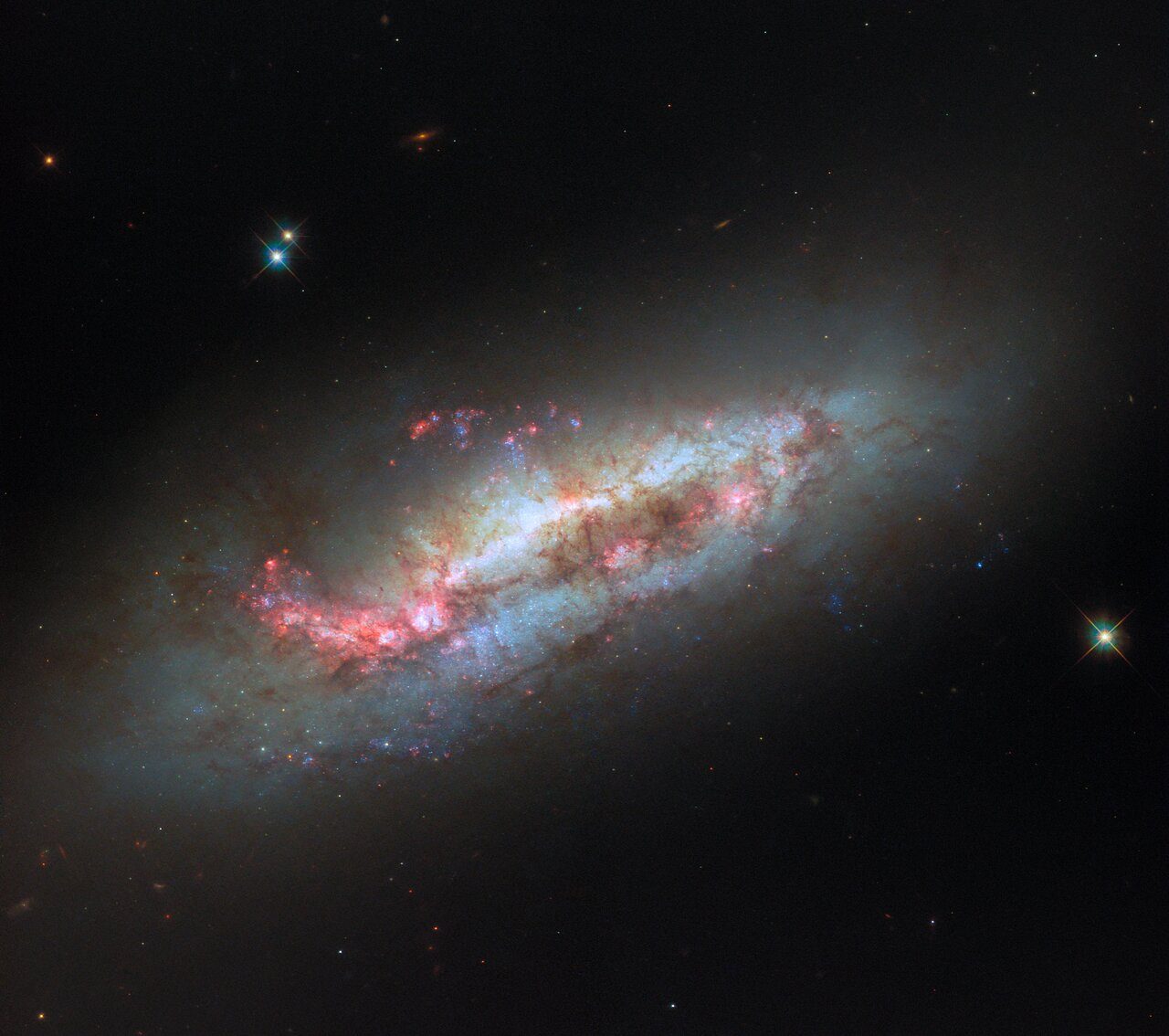
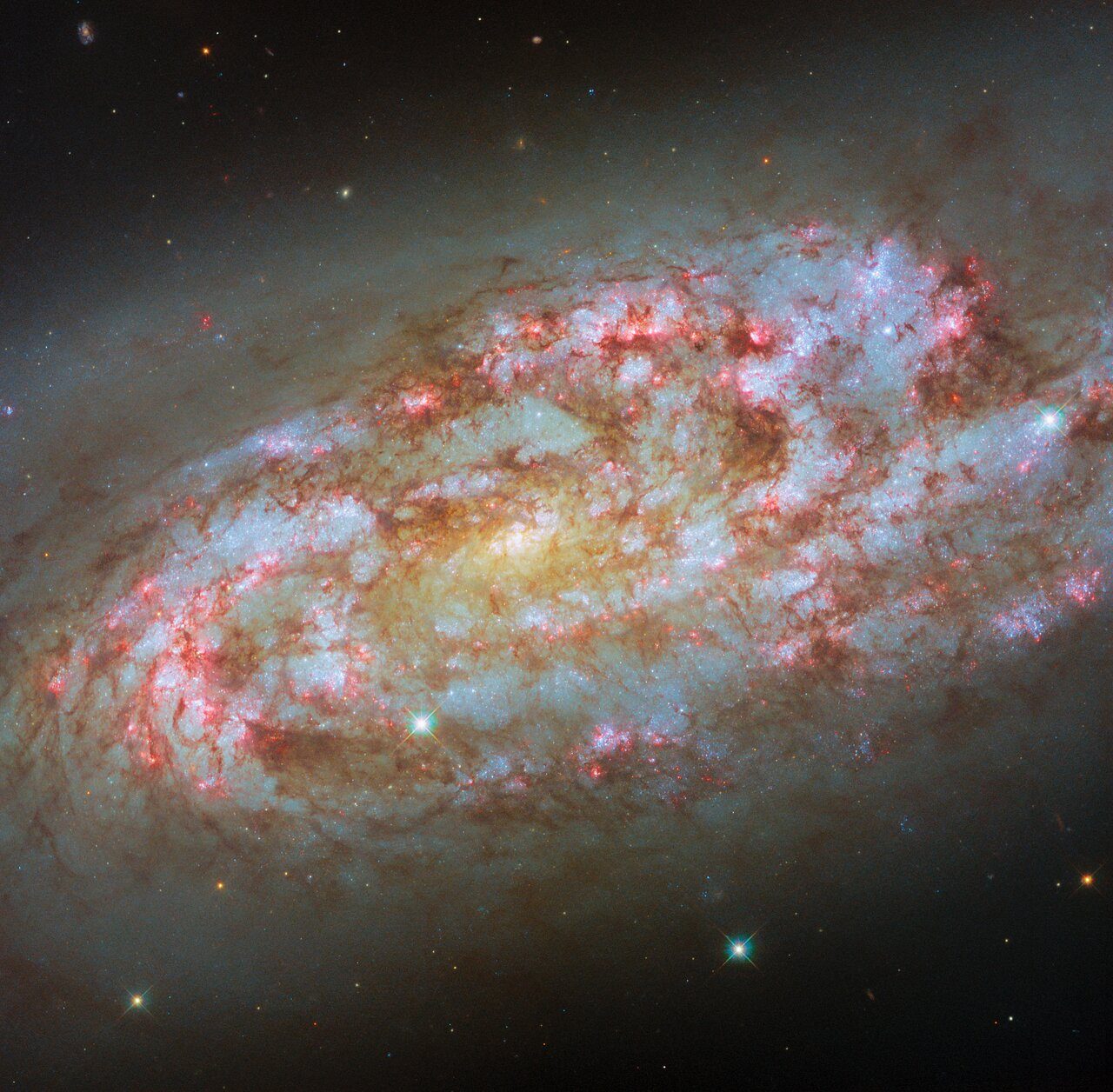
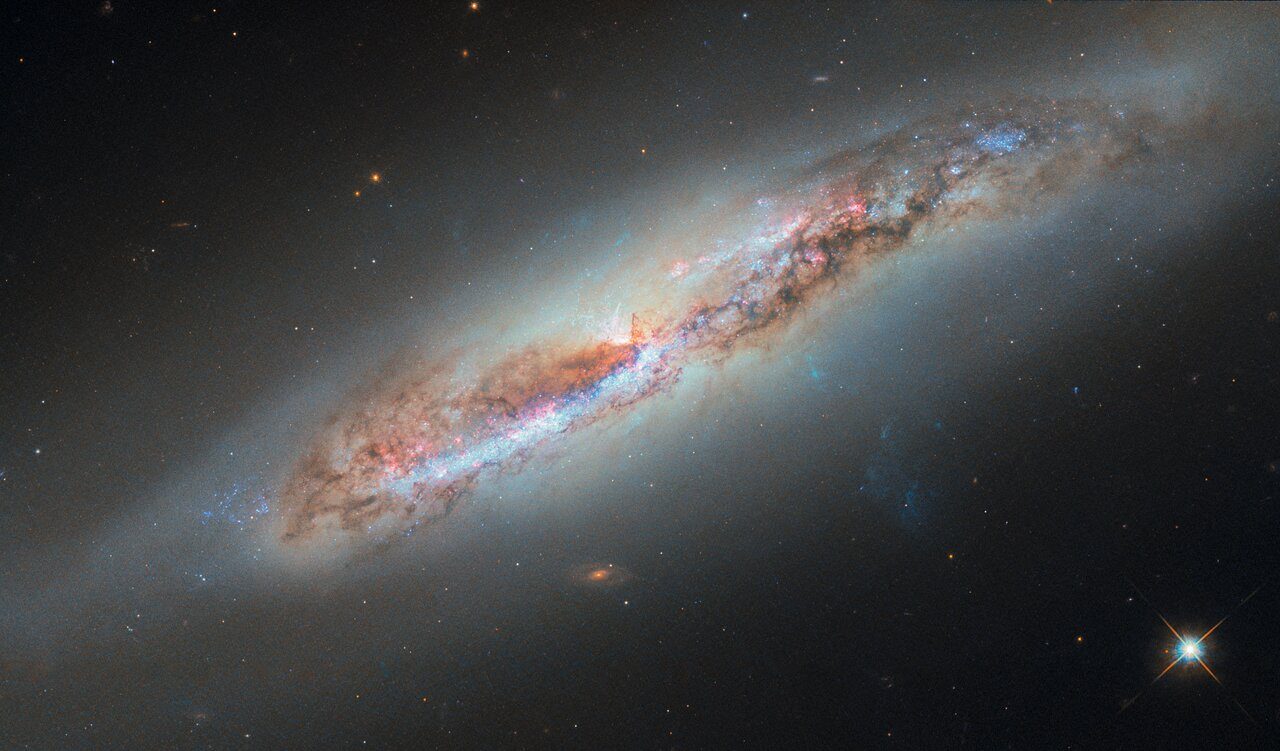
NGC 1511’s dusty disc bears signs of encounters with neighbouring galaxies. Hubble’s view reveals a burst of star formation amid loops and plumes.
| Active satellites | 16,753 |
| Catalogued objects | 32,114 |
| Starlink active | 9,619 |
NGC 1511 is forming stars in a burst of activity while bearing signs of disruptive encounters with its neighbours. Roughly 50 million light-years away in the constellation Hydrus, this peculiar spiral galaxy appears tilted almost edge-on in the ESA/Hubble image.
Its disc glows blue from younger stars in the spiral arms, interrupted by red and pink patches of star-forming gas. Dark dust webs cross the disc, whose light fades into the background. Strange loops and plumes could be traces of past interactions rather than features of an undisturbed spiral.
The likely culprits sit beyond the frame: companion galaxies NGC 1511A and NGC 1511B. A narrow strand of hydrogen connects NGC 1511 to the closer companion, NGC 1511B, which has been stretched and distorted in an apparent past encounter. Researchers have also found evidence that NGC 1511 entirely disrupted another small companion.
Gravity reshapes galaxies — and governs crowded orbits
Researchers will use Hubble’s observations to examine star clusters embedded in NGC 1511’s dusty gas. These clusters offer a way to investigate how matter cycles from interstellar clouds into stars and eventually back into clouds. The image captures not simply a galaxy’s shape, but clues to how encounters can alter its evolution.
Closer to home, gravity also governs the paths of spacecraft and debris, although satellite close approaches are very different from prolonged galactic encounters. Orbital Radar tracking data lists 16,753 active satellites in orbit as of 28 November 2026. Orbital Radar tracking data records 22 active close approaches being tracked as of 28 November 2026.
The Orbital Radar space situational awareness toolkit provides a nearby counterpart to that broader theme: understanding motion matters when objects share a gravitational environment.
Frequently Asked Questions
How far away is NGC 1511?
Why is NGC 1511 described as a disruptive neighbour?
Cite this article
Pick a style, then copy it or download it for your reference manager.Orbital Radar. (2026, November 28). NGC 1511: a disruptive neighbour with a turbulent past. Retrieved November 28, 2026, from https://orbitalradar.com/blog/cosmic-gallery-2026-11-28
“NGC 1511: a disruptive neighbour with a turbulent past.” Orbital Radar, 28 Nov. 2026, orbitalradar.com/blog/cosmic-gallery-2026-11-28. Accessed 28 Nov. 2026.
Orbital Radar (2026) NGC 1511: a disruptive neighbour with a turbulent past. Available at: https://orbitalradar.com/blog/cosmic-gallery-2026-11-28 (Accessed: 28 November 2026).
Orbital Radar. “NGC 1511: a disruptive neighbour with a turbulent past.” Last modified November 28, 2026. https://orbitalradar.com/blog/cosmic-gallery-2026-11-28.
@misc{orbitalradar_blog_cosmic_gallery_2026_11_28,
  author       = {{Orbital Radar}},
  title        = {NGC 1511: a disruptive neighbour with a turbulent past},
  year         = {2026},
  month        = nov,
  howpublished = {\url{https://orbitalradar.com/blog/cosmic-gallery-2026-11-28}},
  url          = {https://orbitalradar.com/blog/cosmic-gallery-2026-11-28},
  urldate      = {2026-11-28},
  note         = {Accessed 2026-11-28}
}
TY - ELEC AU - Orbital Radar, TI - NGC 1511: a disruptive neighbour with a turbulent past PY - 2026 DA - 2026/11/28 PB - Orbital Radar UR - https://orbitalradar.com/blog/cosmic-gallery-2026-11-28 Y2 - 2026/11/28 LA - en ER -
Live figures change, so keep the date you accessed the page. How to cite Orbital Radar