Massive stars leave their mark on blue galaxy Mrk 178
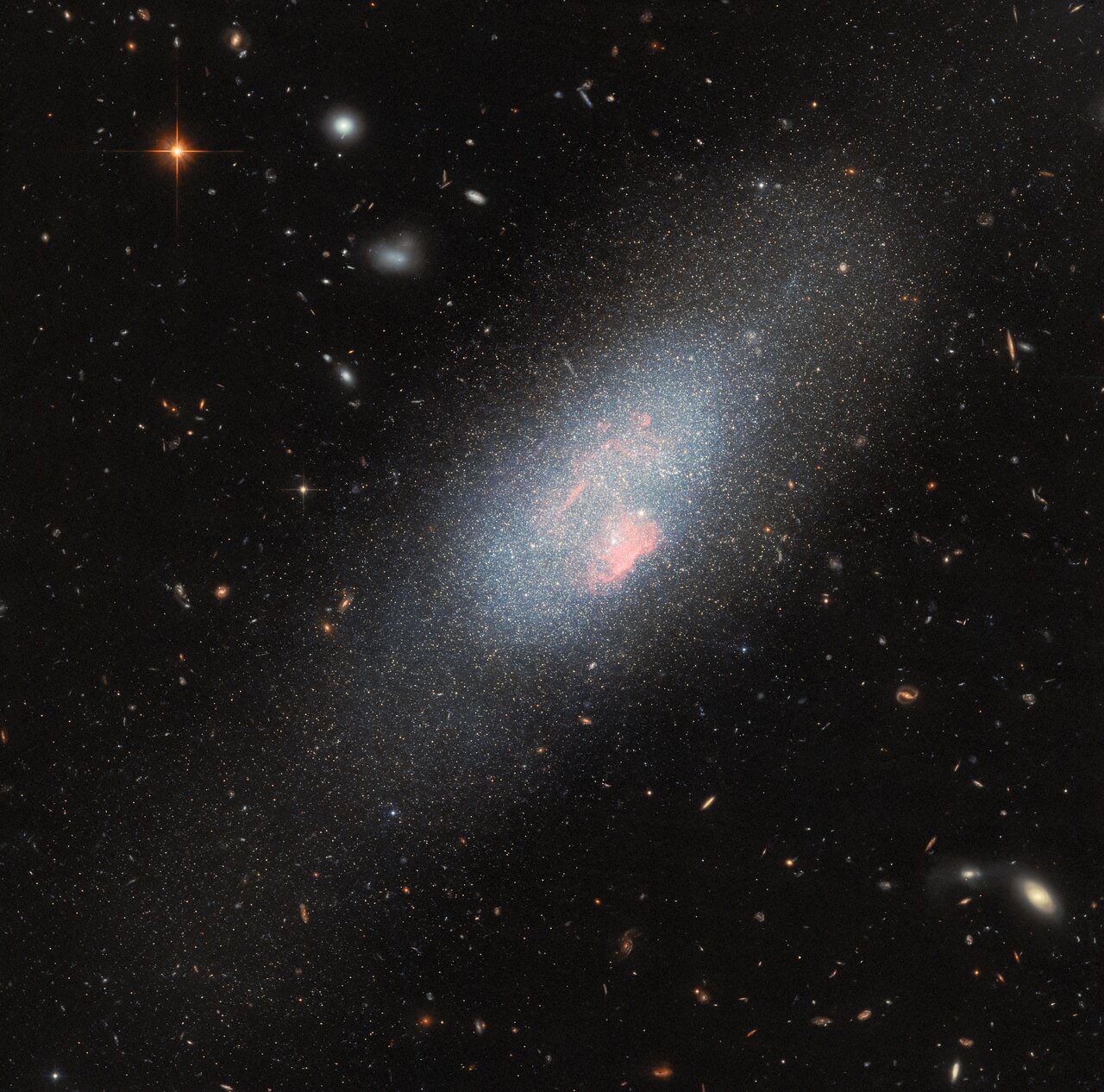
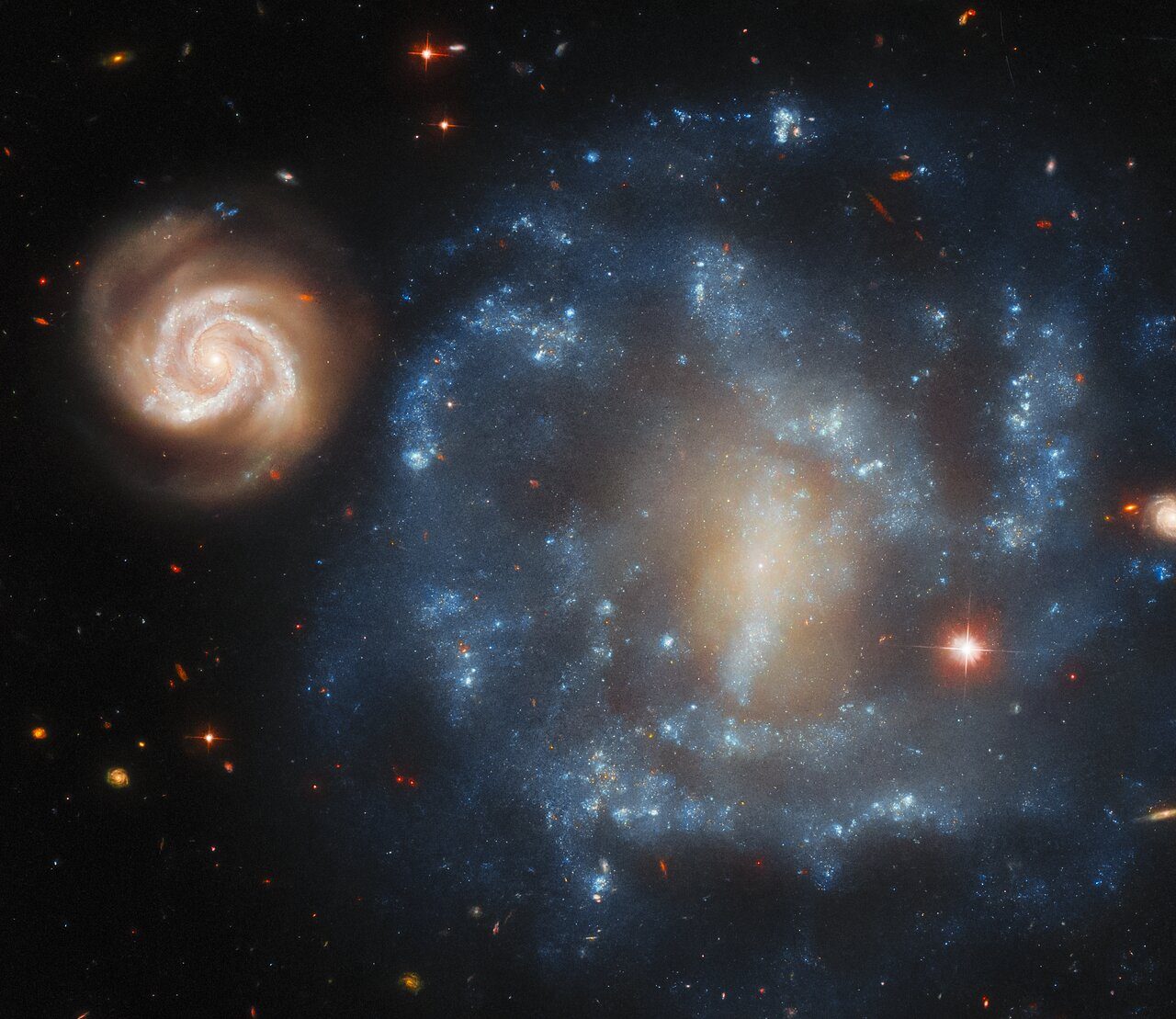
A pale blue galaxy holds evidence of a recent stellar upheaval. Hubble’s view of Markarian 178 reveals massive stars shedding their atmospheres into space.
| Active satellites | 15,920 |
| Catalogued objects | 31,892 |
| Starlink active | 9,980 |
Massive stars are leaving a visible signature on Markarian 178, a blue compact dwarf galaxy 13 million light-years away in Ursa Major. In this ESA/Hubble image, the galaxy resembles a pale blue cloud of tightly packed stars, surrounded by a more dispersed stellar halo. Small glowing gas patches punctuate its core, while a bright reddish region lies near its edge.
The blue light comes from abundant young, hot stars with relatively little dust obscuring them. Among them are rare Wolf–Rayet stars (massive stars shedding their outer atmospheres through powerful winds). Their winds leave bright emission lines—distinctive wavelengths of light—in the galaxy’s spectrum, while ionised hydrogen and oxygen contribute red colouring through Hubble’s specialised filters.
A stellar burst with a faint clue
These short-lived massive stars point to a recent burst of star formation, but Markarian 178 has no obvious close galactic neighbour to explain it. Deep imaging with the Large Binocular Telescope has revealed faint tidal features (structures produced by gravitational interactions), suggesting an encounter with a smaller satellite galaxy. Further high-resolution Hubble observations could help reconstruct when its stars formed.
The image also connects a distant stellar population to the practical business of observing from Earth orbit. According to Orbital Radar tracking data, 15,920 satellites were active in orbit on 31 October 2026. Orbital Radar’s Satellite Library provides a way to explore the spacecraft population sharing that environment.
Orbital Radar’s live catalogue contained 31,892 objects, including debris, on 31 October 2026. That nearby orbital population is a different subject from the stars in this image: Markarian 178’s scientific story is written in stellar light, glowing gas and the faint gravitational traces of a past encounter.
Frequently Asked Questions
Where is Markarian 178?
Why are Wolf–Rayet stars important in Markarian 178?
📎 Cite this article · data available
Orbital Radar Newsroom. (2026). Massive stars leave their mark on blue galaxy Mrk 178. Orbital Radar. https://orbitalradar.com/blog/cosmic-gallery-2026-10-31"Massive stars leave their mark on blue galaxy Mrk 178." Orbital Radar, 31 October 2026, https://orbitalradar.com/blog/cosmic-gallery-2026-10-31.@misc{orbitalradar_cosmic_gallery_2026_10_31,
title = {Massive stars leave their mark on blue galaxy Mrk 178},
author = {{Orbital Radar}},
year = {2026},
howpublished = {\url{https://orbitalradar.com/blog/cosmic-gallery-2026-10-31}}
}