Webb reveals stellar beginnings in Orion’s dusty nursery
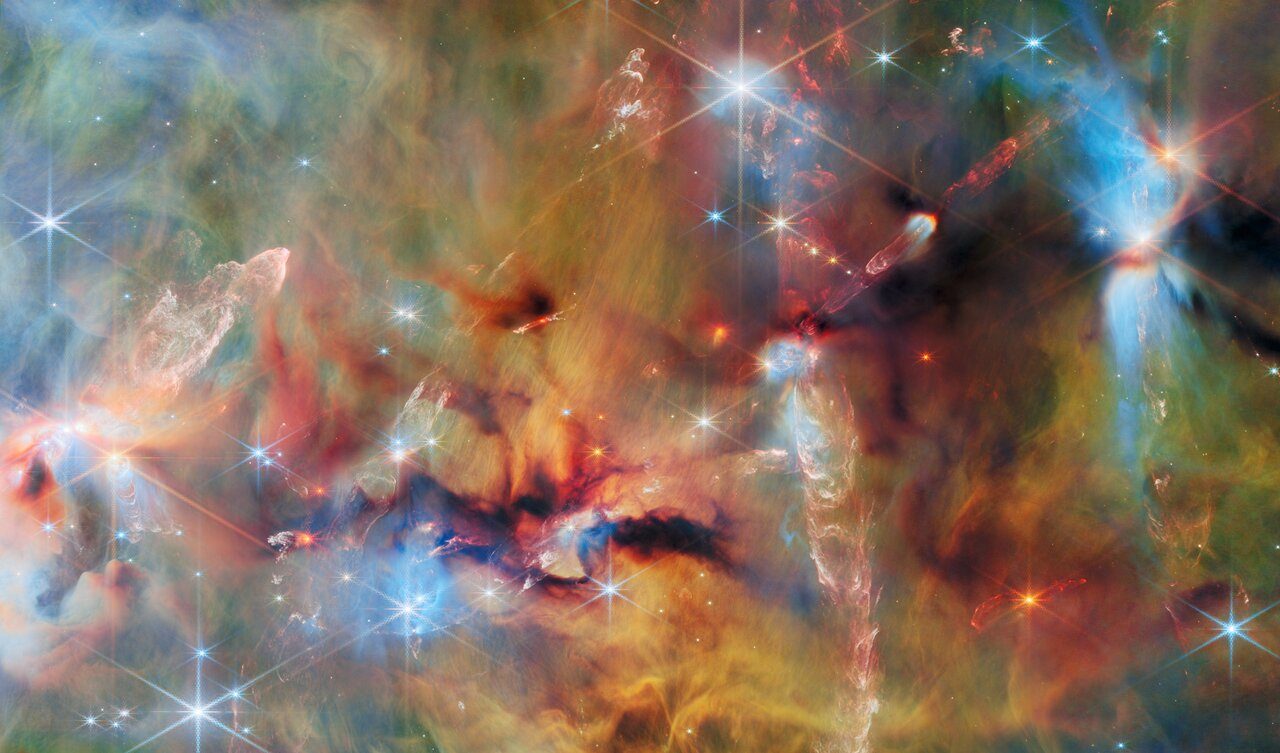
Webb reveals a stellar nursery behind the Orion Nebula, where hidden protostars drive glowing outflows and emerging stars illuminate their surroundings.
| Active satellites | 15,923 |
| Catalogued objects | 31,876 |
| Starlink active | 9,980 |
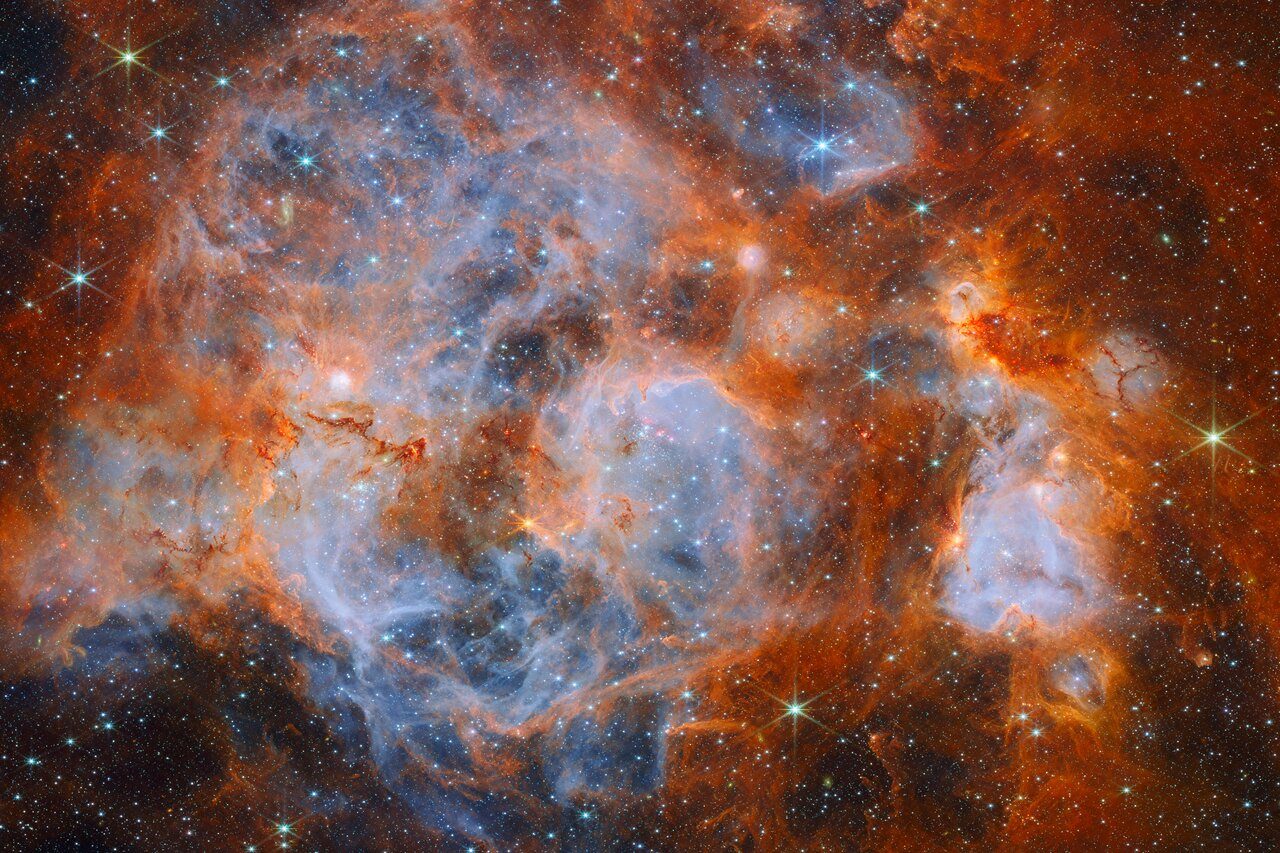
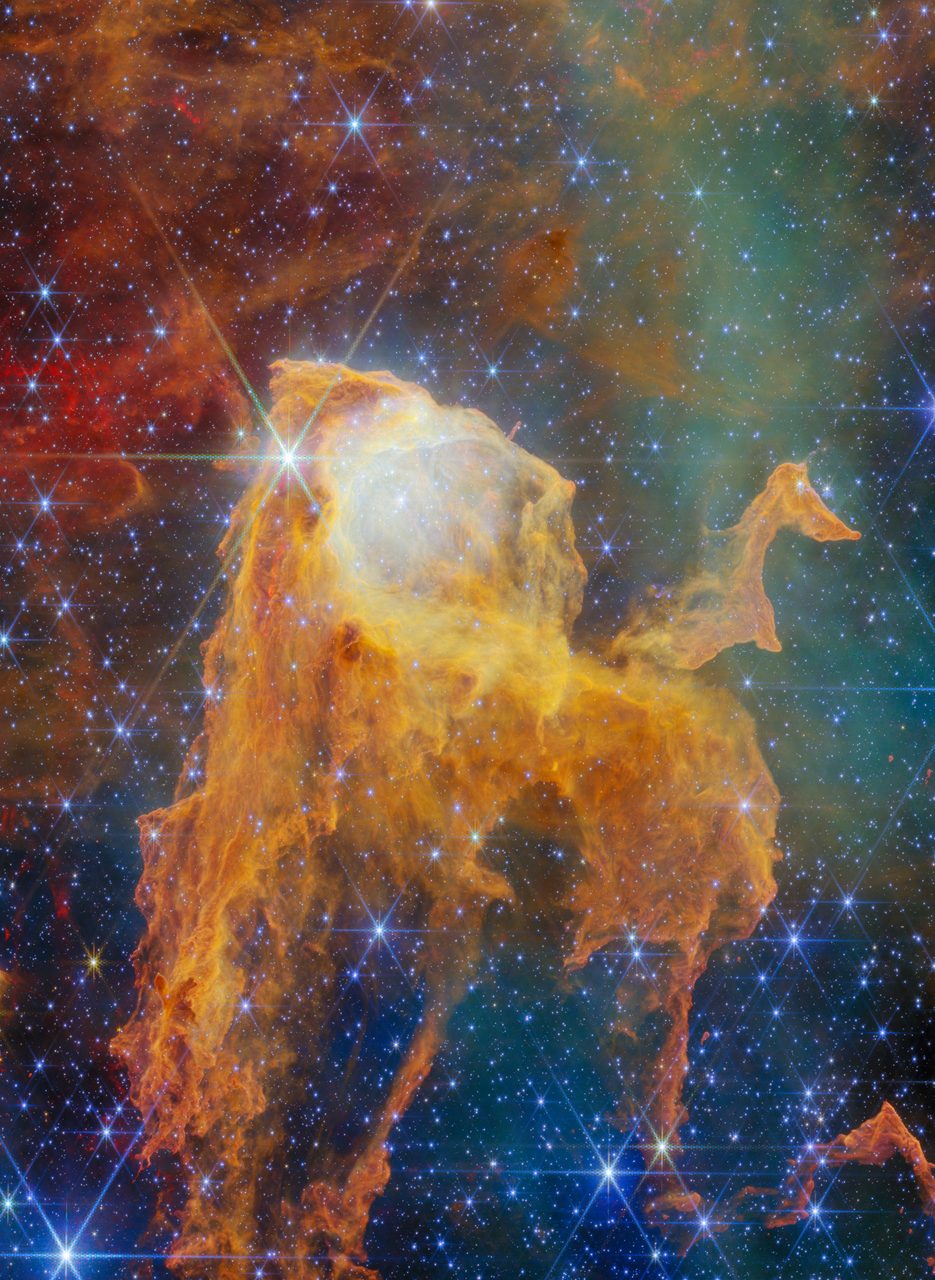
Young stars at different stages of formation share this James Webb Space Telescope view of OMC-2, a dense cloud behind the Orion Nebula. Just 2.5 light-years across, the scene contains stellar embryos, planet-forming discs and emerging stars that have cleared their immediate surroundings.
Located 1280 light-years from Earth, this northern portion of OMC-2 belongs to the much larger Orion A molecular cloud. Webb’s Near-Infrared Camera (NIRCam) reveals billowing outflows, bright stars and swirling material interrupted by dark, obscuring clouds.
Gravity draws dense gas into protostars (growing stars fed by surrounding material through a rotating disc). As material falls inward, it heats up; jets escaping from the stellar poles drive shockwaves into nearby gas, producing glowing ridges. Some protostars remain hidden, but their outflows mark where they are growing.
Reading a nursery, not a timeline
The image brings different stages of stellar development into the same field, rather than following a single star through time. Compare the obscured sources traced by outflows with the brighter, more evolved stars illuminating the cloud: their surroundings reveal how star formation reshapes its raw material.
Studying that distant environment differs from monitoring the spacecraft around Earth. Orbital Radar tracking data lists 15923 active satellites in orbit as of 30 October 2026. Orbital Radar’s live catalogue contains 31876 objects, including debris, as of 30 October 2026.
Those nearby objects belong to a different observational landscape from Orion’s stellar nursery. Orbital Radar’s Space Academy offers background on the space science behind such distinctions, while this Webb view rewards a closer look at the glowing ridges that trace otherwise hidden activity.
Frequently Asked Questions
What does Webb’s image of OMC-2 show?
Why do the outflows in OMC-2 glow?
📎 Cite this article · data available
Orbital Radar Newsroom. (2026). Webb reveals stellar beginnings in Orion’s dusty nursery. Orbital Radar. https://orbitalradar.com/blog/cosmic-gallery-2026-10-30"Webb reveals stellar beginnings in Orion’s dusty nursery." Orbital Radar, 30 October 2026, https://orbitalradar.com/blog/cosmic-gallery-2026-10-30.@misc{orbitalradar_cosmic_gallery_2026_10_30,
title = {Webb reveals stellar beginnings in Orion’s dusty nursery},
author = {{Orbital Radar}},
year = {2026},
howpublished = {\url{https://orbitalradar.com/blog/cosmic-gallery-2026-10-30}}
}