Stars on demand: four lasers sharpen a black hole’s view
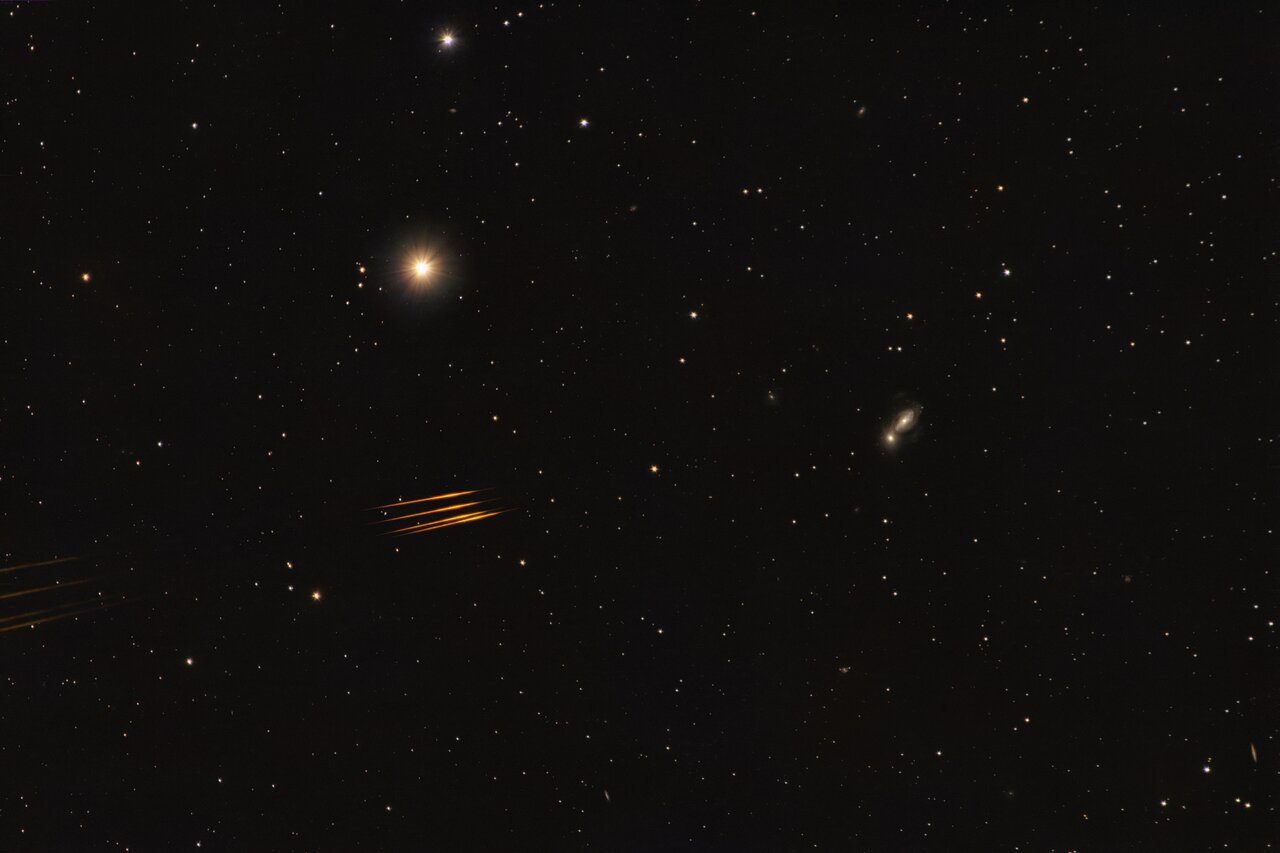
Four yellow streaks above ESO’s Very Large Telescope are artificial stars, created to correct atmospheric blur and sharpen observations of a distant galaxy’s active centre.
| Active satellites | 16,659 |
| Catalogued objects | 32,018 |
| Starlink active | 9,897 |
Four bright yellow streaks in this ESO image are artificial stars, not beams aimed at the galaxies to their right. Generated by lasers rising from the Very Large Telescope’s four Unit Telescopes in Chile, they give astronomers reference points for measuring the atmosphere’s distortion of starlight.
The beams encounter sodium atoms about 90 km above the ground, making them glow. That sodium occupies a layer roughly 5–10 km thick: photographed from 2.5 km away, its illuminated columns appear elongated, while from the telescopes sending up the beams they look like points.
Adaptive optics (technology that corrects atmospheric distortion) monitors these artificial stars and drives a thin, flexible mirror that changes shape hundreds of times per second. Those adjustments counteract the shifting blur, bringing the astronomical target into sharper focus.
A clearer view from beneath the atmosphere
The target here is the supermassive black hole at the centre of NGC 3227. Gas drawn towards the black hole powers its bright, active centre, which ESO astronomer James Leftley is studying with the GRAVITY and MATISSE instruments.
The VLT Interferometer (a system combining light from separate telescopes) links the four Unit Telescopes to work like a telescope up to 130 metres across. Lasers added through the GRAVITY+ upgrade extend atmospheric correction across almost the entire southern sky; these artificial stars are atmospheric beacons, not orbiting spacecraft.
Orbital Radar tracking data lists 16,659 active satellites in orbit as of 5 November 2026. Orbital Radar’s live catalogue contains 32,018 objects, including debris, as of 5 November 2026.
For readers turning from this distant galaxy to objects crossing their own sky, Orbital Radar’s Pass Predictor identifies visible satellite passes. The distinction matters: satellites travel around Earth, whereas these laser-created reference points glow within its atmosphere.
Frequently Asked Questions
Why do the VLT’s artificial stars look like streaks?
How do artificial stars help astronomers study NGC 3227?
Cite this article
Pick a style, then copy it or download it for your reference manager.Orbital Radar. (2026, November 5). Stars on demand: four lasers sharpen a black hole’s view. Retrieved November 5, 2026, from https://orbitalradar.com/blog/cosmic-gallery-2026-11-05
“Stars on demand: four lasers sharpen a black hole’s view.” Orbital Radar, 5 Nov. 2026, orbitalradar.com/blog/cosmic-gallery-2026-11-05. Accessed 5 Nov. 2026.
Orbital Radar (2026) Stars on demand: four lasers sharpen a black hole’s view. Available at: https://orbitalradar.com/blog/cosmic-gallery-2026-11-05 (Accessed: 5 November 2026).
Orbital Radar. “Stars on demand: four lasers sharpen a black hole’s view.” Last modified November 5, 2026. https://orbitalradar.com/blog/cosmic-gallery-2026-11-05.
@misc{orbitalradar_blog_cosmic_gallery_2026_11_05,
  author       = {{Orbital Radar}},
  title        = {Stars on demand: four lasers sharpen a black hole’s view},
  year         = {2026},
  month        = nov,
  howpublished = {\url{https://orbitalradar.com/blog/cosmic-gallery-2026-11-05}},
  url          = {https://orbitalradar.com/blog/cosmic-gallery-2026-11-05},
  urldate      = {2026-11-05},
  note         = {Accessed 2026-11-05}
}
TY - ELEC AU - Orbital Radar, TI - Stars on demand: four lasers sharpen a black hole’s view PY - 2026 DA - 2026/11/05 PB - Orbital Radar UR - https://orbitalradar.com/blog/cosmic-gallery-2026-11-05 Y2 - 2026/11/05 LA - en ER -
Live figures change, so keep the date you accessed the page. How to cite Orbital Radar