A storm of new stars: Hubble reveals NGC 1792's glow
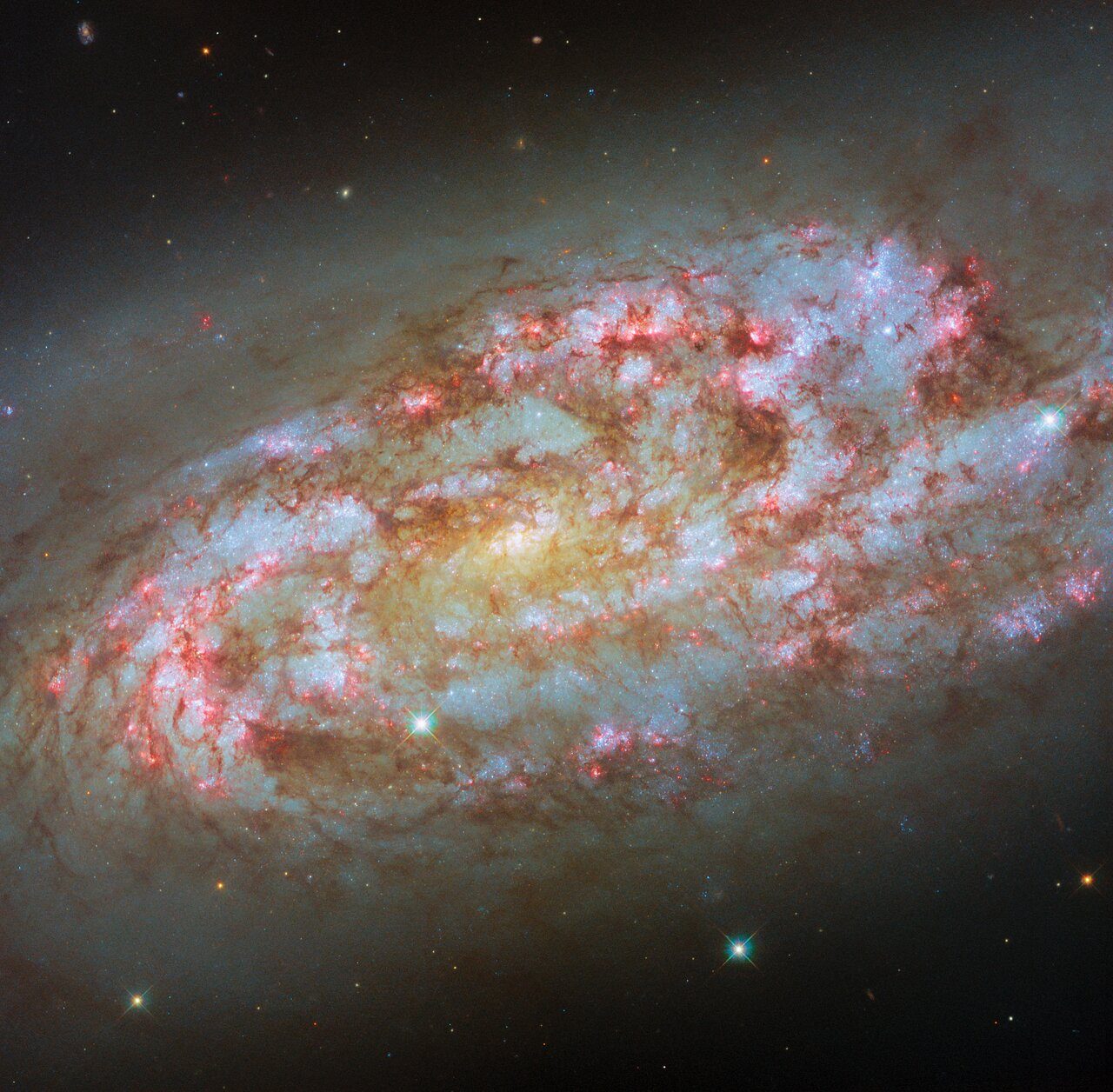
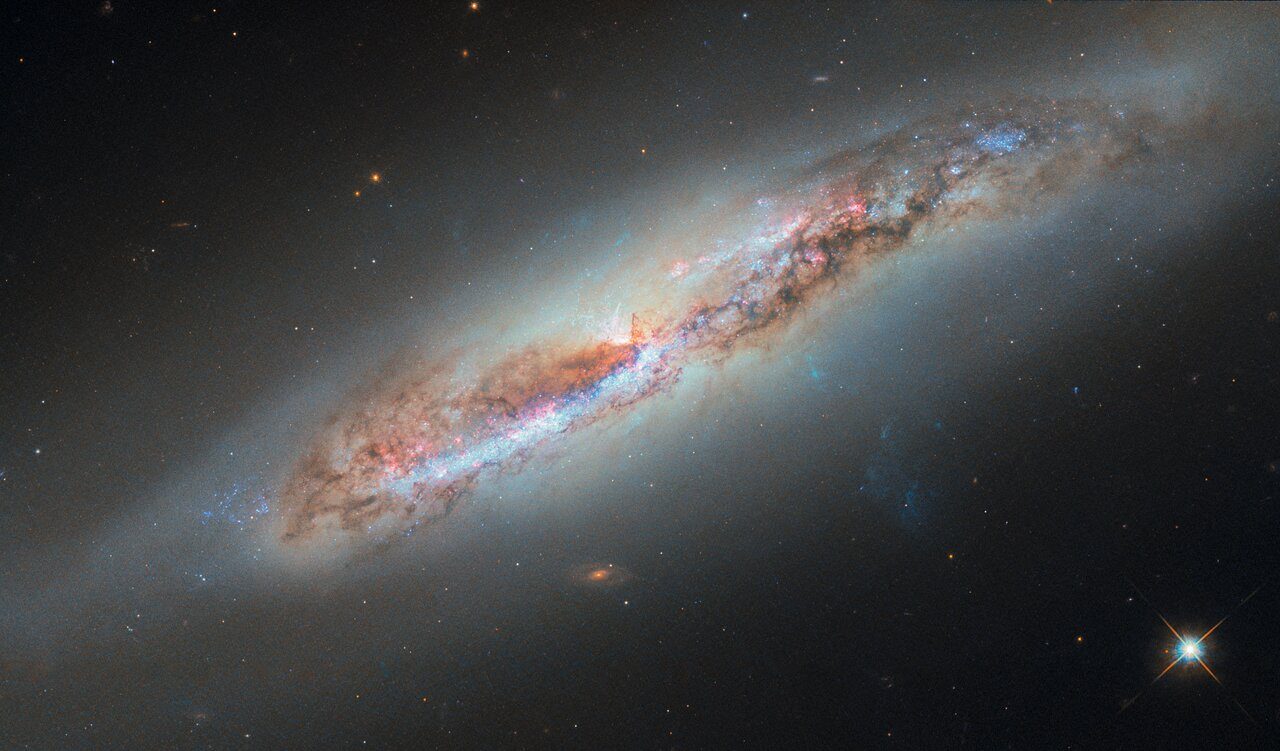
Red clouds and blue star clusters trace a burst of star formation in NGC 1792. Hubble's deeper view reveals a galaxy whose activity may be driven by its neighbour.
| Active satellites | 16,613 |
| Catalogued objects | 31,992 |
| Starlink active | 9,903 |
NGC 1792 is forming stars in a turbulent spiral disc more than 50 million light-years from Earth, in the constellation Columba (the Dove). This Hubble image shows patchy arms dotted with sparkling blue star clusters and glowing red nebulae, threaded by thick clumps of dark dust around a bright centre.
Astronomers classify NGC 1792 as a starburst galaxy (a galaxy undergoing unusually intense star formation). Its larger neighbour, NGC 1808, is thought to be stirring its gas through gravitational interaction, encouraging star formation most strongly on the side where that influence is greater. The galaxy is unusually luminous for its mass.
The red patches trace H-alpha emission (a particular wavelength of light emitted by hydrogen). Young stars produce ultraviolet radiation that ionises the surrounding gas, stripping electrons from atoms; as electrons recombine with hydrogen nuclei and settle into lower energy states, the gas emits characteristic light. These glowing regions therefore mark the neighbourhoods of newly formed stars.
Reading the light, understanding the environment
Hubble previously showed NGC 1792 in 2020; this image adds observations collected throughout 2025. The deeper view helps astronomers investigate how gas, star clusters and supernovae interact, rather than simply counting bright patches in the spiral arms.
Studying that distant activity also depends on spacecraft operating much closer to home. As of today, Orbital Radar tracking data lists 16,613 active satellites in Earth orbit. Orbital Radar's live catalogue contains 31,992 objects, including debris, as of today.
Those figures describe Earth's orbital environment, not the galaxy pictured here. Readers can explore that nearer setting through Orbital Radar's space situational awareness toolkit, which brings together tools for understanding spacecraft and the objects sharing their orbital space.
Frequently Asked Questions
Where is NGC 1792?
Why are there red patches in Hubble's image of NGC 1792?
Cite this article
Pick a style, then copy it or download it for your reference manager.Orbital Radar. (2026, November 4). A storm of new stars: Hubble reveals NGC 1792's glow. Retrieved November 4, 2026, from https://orbitalradar.com/blog/cosmic-gallery-2026-11-04
“A storm of new stars: Hubble reveals NGC 1792's glow.” Orbital Radar, 4 Nov. 2026, orbitalradar.com/blog/cosmic-gallery-2026-11-04. Accessed 4 Nov. 2026.
Orbital Radar (2026) A storm of new stars: Hubble reveals NGC 1792's glow. Available at: https://orbitalradar.com/blog/cosmic-gallery-2026-11-04 (Accessed: 4 November 2026).
Orbital Radar. “A storm of new stars: Hubble reveals NGC 1792's glow.” Last modified November 4, 2026. https://orbitalradar.com/blog/cosmic-gallery-2026-11-04.
@misc{orbitalradar_blog_cosmic_gallery_2026_11_04,
  author       = {{Orbital Radar}},
  title        = {A storm of new stars: Hubble reveals NGC 1792's glow},
  year         = {2026},
  month        = nov,
  howpublished = {\url{https://orbitalradar.com/blog/cosmic-gallery-2026-11-04}},
  url          = {https://orbitalradar.com/blog/cosmic-gallery-2026-11-04},
  urldate      = {2026-11-04},
  note         = {Accessed 2026-11-04}
}
TY - ELEC AU - Orbital Radar, TI - A storm of new stars: Hubble reveals NGC 1792's glow PY - 2026 DA - 2026/11/04 PB - Orbital Radar UR - https://orbitalradar.com/blog/cosmic-gallery-2026-11-04 Y2 - 2026/11/04 LA - en ER -
Live figures change, so keep the date you accessed the page. How to cite Orbital Radar