All-Nighter on Kitt Peak: An Eclipse Above the Telescopes
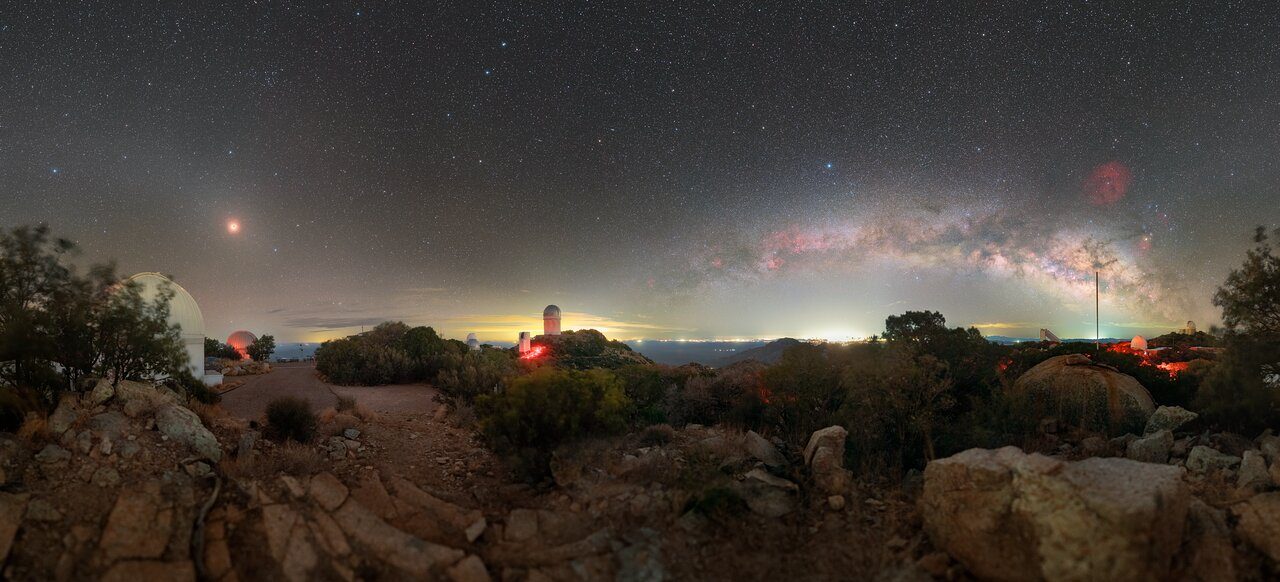
An eclipsed Moon hangs above Kitt Peak’s telescopes as the Milky Way arcs across the sky, bringing Earth’s shadow and the wider Galaxy into the same view.
| Active satellites | 15,954 |
| Catalogued objects | 31,932 |
| Starlink active | 9,916 |
An eclipsed full Moon shares the sky with the Milky Way above Kitt Peak National Observatory in this photograph from the total lunar eclipse of 3 March 2026. Petr Horálek’s panorama places the observatory’s telescope buildings beneath a sky shaped by both our immediate celestial neighbourhood and the wider Galaxy.
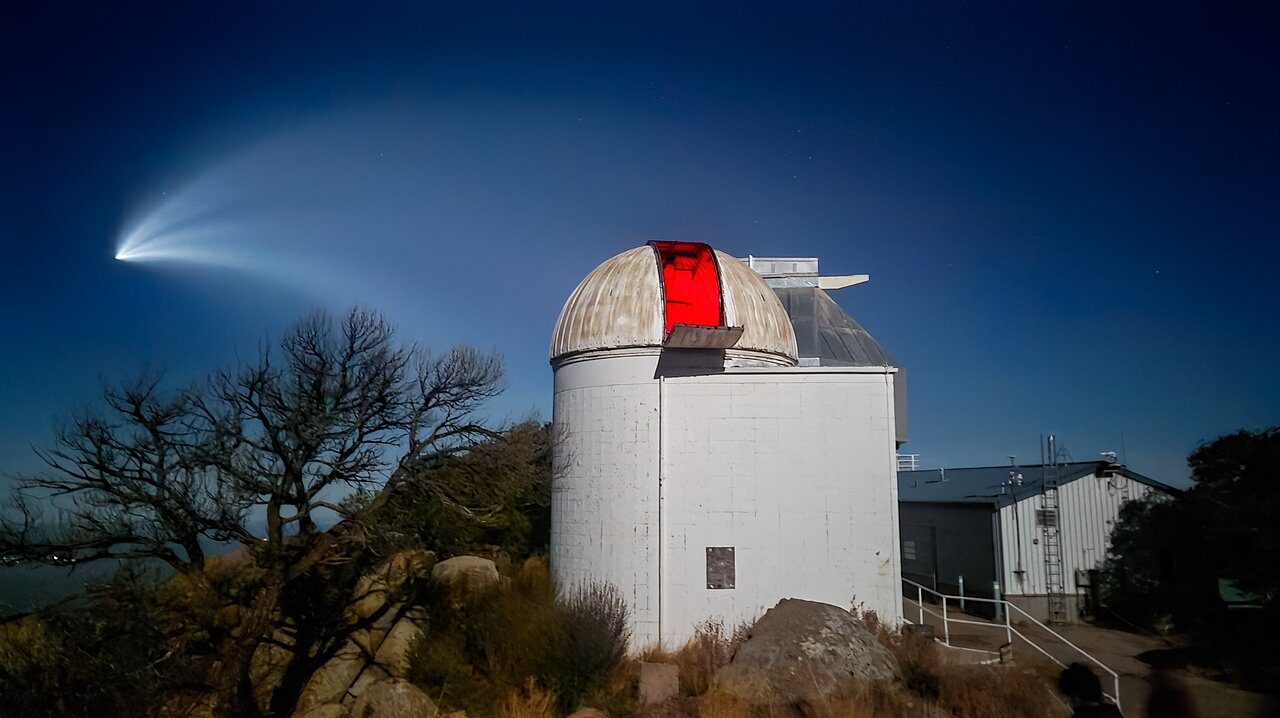
On the left, the Burrell Schmidt and SARA Kitt Peak telescopes sit below the Moon. Across the centre, the Spacewatch telescopes, Bok telescope and Nicholas U. Mayall telescope are framed by thin stratus clouds; farther around the view stand McMath-Pierce, the Robotically Controlled Telescope and the KPNO telescope.
Above the Milky Way, the red emission nebula Sh2-27 surrounds Zeta Ophiuchi. An emission nebula is a cloud of gas that glows as energised atoms release light. Below it, Tucson’s city lights brighten the horizon, contrasting artificial illumination with the Galaxy’s stellar band.
Earth’s shadow, and a changing orbital sky
A total lunar eclipse occurs when the Moon passes entirely into Earth’s umbra (the central part of its shadow). Sunlight filtered and bent through Earth’s atmosphere can still reach the lunar surface, explaining why an eclipsed Moon can remain visible rather than disappearing.
The same skies also accommodate a growing population of spacecraft, although the publisher identifies no satellite trails in this image. Orbital Radar tracking data lists 15,954 active satellites in orbit in 2026. Orbital Radar’s live catalogue records 31,932 objects, including debris, in 2026.
Those populations form another layer of context for ground-based astronomy, distinct from the natural alignment captured here. Orbital Radar’s Moon Globe shows the Moon’s current position and phase, while the Pass Predictor helps observers anticipate visible spacecraft passes above their own horizon.
Frequently Asked Questions
When was the Kitt Peak lunar eclipse photograph taken?
What is the red nebula above the Milky Way in the image?
📎 Cite this article · data available
Orbital Radar Newsroom. (2026). All-Nighter on Kitt Peak: An Eclipse Above the Telescopes. Orbital Radar. https://orbitalradar.com/blog/cosmic-gallery-2026-11-02"All-Nighter on Kitt Peak: An Eclipse Above the Telescopes." Orbital Radar, 2 November 2026, https://orbitalradar.com/blog/cosmic-gallery-2026-11-02.@misc{orbitalradar_cosmic_gallery_2026_11_02,
title = {All-Nighter on Kitt Peak: An Eclipse Above the Telescopes},
author = {{Orbital Radar}},
year = {2026},
howpublished = {\url{https://orbitalradar.com/blog/cosmic-gallery-2026-11-02}}
}