A beacon in swirling dust: Webb reveals Messier 77’s core
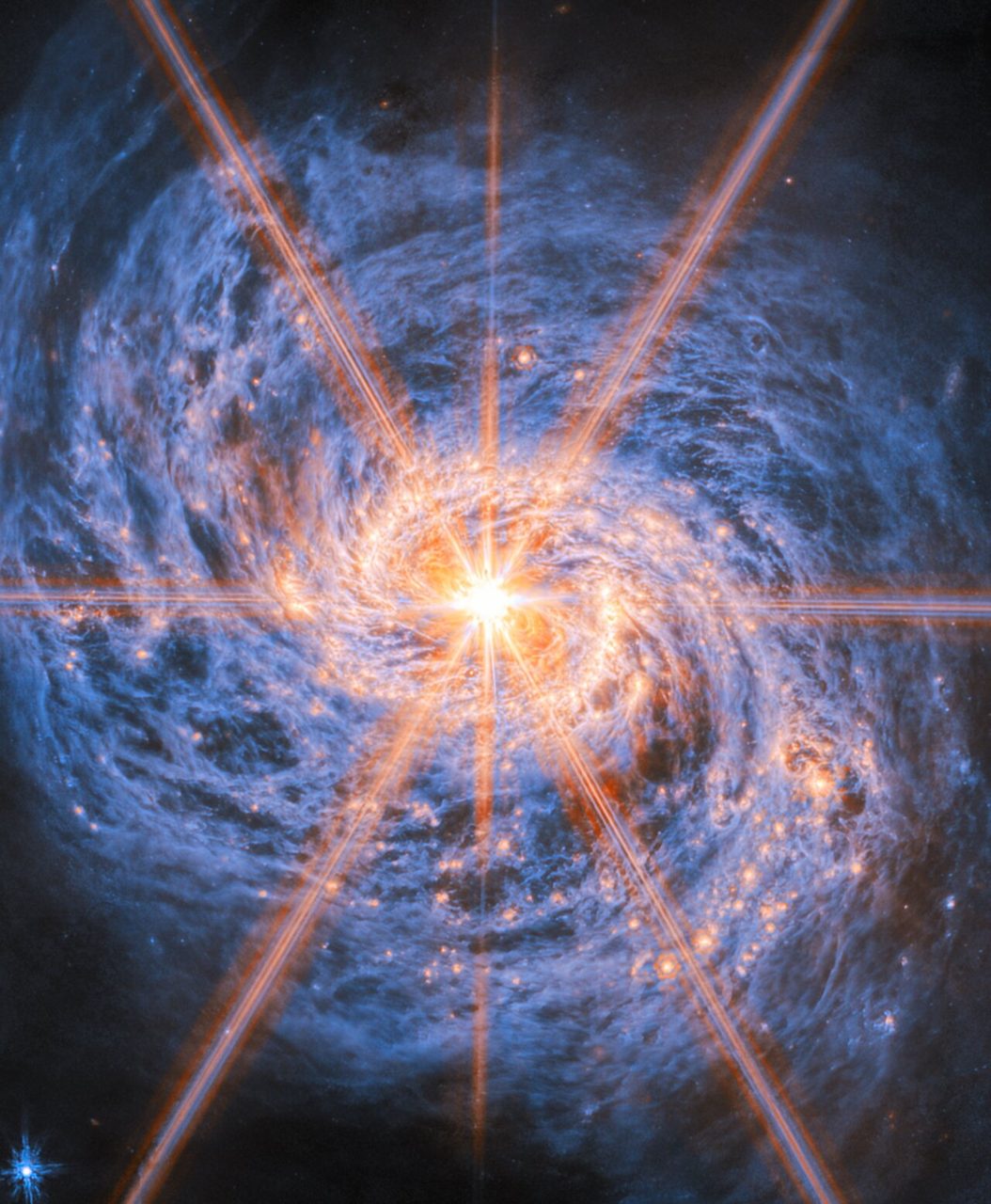
A brilliant nucleus pierces the dusty spiral arms of Messier 77 in Webb’s infrared view, revealing how black-hole activity and star formation share a galaxy.
| Active satellites | 15,951 |
| Catalogued objects | 31,955 |
| Starlink active | 9,906 |
Messier 77’s brilliant centre shines through swirling dust in this James Webb Space Telescope portrait, its light intense enough to produce spikes across the image. Located 45 million light-years away in Cetus, the barred spiral galaxy brings two powerful processes into view: matter heating around a central black hole and stars forming throughout its dusty disc.
Webb’s Mid-Infrared Instrument (MIRI) records the glow of interstellar dust grains, represented here in blue. Their smoky filaments surround cavities, while orange bubbles mark regions carved out by newly formed star clusters. A bright starburst ring (a region of unusually intense star formation) encircles the central region.
The beacon itself is an active galactic nucleus (AGN), a compact, luminous region powered by a black hole with eight million times the Sun’s mass. Gas drawn into tight, rapid orbits collides and heats up, releasing radiation; the light comes from this surrounding material, not from inside the black hole.
Reading the light, not just the shapes
The orange lines radiating from the nucleus are diffraction spikes (patterns caused by light bending around telescope structures), not jets or arms belonging to M77. Webb’s mirror edges and a secondary-mirror support produce the distinctive pattern when a source is sufficiently bright and compact. Here, a galactic nucleus creates an effect more commonly associated with stars.
Different wavelengths reveal different structures: the publisher’s near-infrared view reveals a central bar that does not appear in visible-light images, while MIRI traces glowing dust. The distinction is a reminder that an astronomical image records how matter interacts with light, rather than simply reproducing an everyday view.
Closer to Earth, Orbital Radar’s Satellite Library offers a separate perspective on the spacecraft population around our planet. Orbital Radar tracking data lists 15,951 active satellites as of 3 November 2026. Orbital Radar’s live catalogue contains 31,955 objects, including debris, as of 3 November 2026.
Frequently Asked Questions
What powers the bright centre of Messier 77?
Are the orange spikes in Webb’s Messier 77 image real galactic structures?
Cite this article
Pick a style, then copy it or download it for your reference manager.Orbital Radar. (2026, November 3). A beacon in swirling dust: Webb reveals Messier 77’s core. Retrieved November 3, 2026, from https://orbitalradar.com/blog/cosmic-gallery-2026-11-03
“A beacon in swirling dust: Webb reveals Messier 77’s core.” Orbital Radar, 3 Nov. 2026, orbitalradar.com/blog/cosmic-gallery-2026-11-03. Accessed 3 Nov. 2026.
Orbital Radar (2026) A beacon in swirling dust: Webb reveals Messier 77’s core. Available at: https://orbitalradar.com/blog/cosmic-gallery-2026-11-03 (Accessed: 3 November 2026).
Orbital Radar. “A beacon in swirling dust: Webb reveals Messier 77’s core.” Last modified November 3, 2026. https://orbitalradar.com/blog/cosmic-gallery-2026-11-03.
@misc{orbitalradar_blog_cosmic_gallery_2026_11_03,
  author       = {{Orbital Radar}},
  title        = {A beacon in swirling dust: Webb reveals Messier 77’s core},
  year         = {2026},
  month        = nov,
  howpublished = {\url{https://orbitalradar.com/blog/cosmic-gallery-2026-11-03}},
  url          = {https://orbitalradar.com/blog/cosmic-gallery-2026-11-03},
  urldate      = {2026-11-03},
  note         = {Accessed 2026-11-03}
}
TY - ELEC AU - Orbital Radar, TI - A beacon in swirling dust: Webb reveals Messier 77’s core PY - 2026 DA - 2026/11/03 PB - Orbital Radar UR - https://orbitalradar.com/blog/cosmic-gallery-2026-11-03 Y2 - 2026/11/03 LA - en ER -
Live figures change, so keep the date you accessed the page. How to cite Orbital Radar