Home Library Launch Vehicles SLS
🚀 Launch Vehicle Profile

SLS — Space Launch System

NASA's super heavy-lift rocket for the Artemis programme — the most powerful rocket to successfully reach orbit, designed to carry astronauts to the Moon and deep space.

Overview

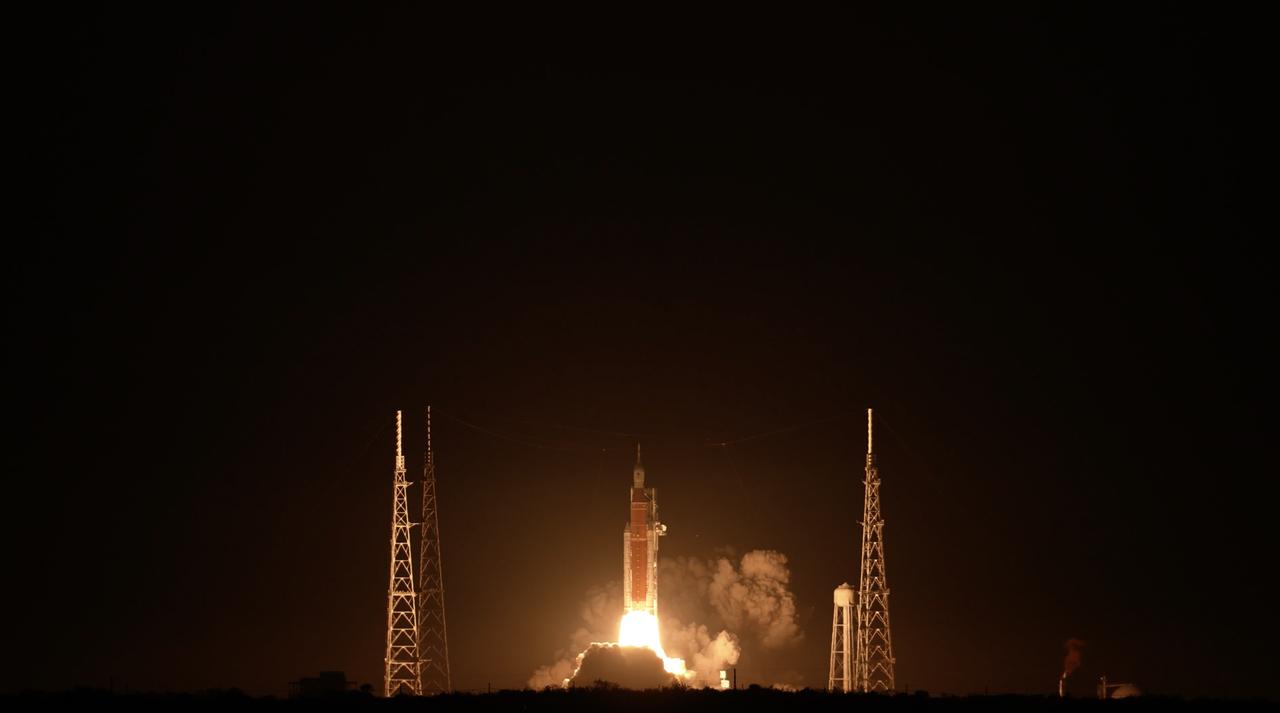
The Space Launch System (SLS) is NASA's super heavy-lift expendable launch vehicle, developed to support deep-space exploration missions under the Artemis programme. SLS launched successfully for the first time on Artemis I in November 2022, sending the uncrewed Orion capsule around the Moon and back. It is the most powerful rocket to have completed a successful orbital mission, producing 39,144 kN (8.8 million lbf) of thrust at liftoff.

95,000 kg
Payload to LEO (Block 1)
27,000 kg
To Trans-Lunar Injection
8.8M lbf
Liftoff Thrust

Key Specifications (Block 1)

ParameterValue
OperatorNASA (prime contractor: Boeing)
First Flight16 November 2022 (Artemis I)
Height98.1 m (322 ft)
Diameter8.4 m (core stage)
Liftoff Mass~2,608,000 kg
Core Stage Engines4 × RS-25 (former Shuttle main engines)
Solid Rocket Boosters2 × 5-segment SRBs (Northrop Grumman)
Upper StageICPS (Interim Cryogenic Propulsion Stage, 1 × RL10)
Payload to LEO95,000 kg
Payload to TLI27,000 kg
ReusabilityFully expendable
Launch SiteLC-39B, Kennedy Space Center, Florida

Block Variants

Block 1: The initial configuration, used for Artemis I and planned for Artemis II. Uses the ICPS upper stage with a single RL10 engine. 27,000 kg to trans-lunar injection (TLI).

Block 1B: Replaces the ICPS with the more powerful Exploration Upper Stage (EUS), featuring four RL10 engines. Increases TLI capacity to ~38,000 kg. Planned for Artemis IV and beyond.

Block 2: A future upgrade with advanced boosters replacing the SRBs, targeting 46,000 kg to TLI and 130,000 kg to LEO. Timeline uncertain.

Artemis I

SLS's maiden flight on 16 November 2022 was a success. The rocket launched the uncrewed Orion capsule on a 25.5-day mission that included a distant retrograde orbit around the Moon, reaching a maximum distance of 432,210 km from Earth — the farthest a human-rated spacecraft has ever travelled. Orion returned safely with a precision splashdown in the Pacific Ocean.

Criticism and Cost

SLS has faced criticism for its high per-launch cost (estimated at $2.2–4.1 billion per mission including manufacturing and operations) and its fully expendable design. Unlike SpaceX's reusable Falcon Heavy and Starship, every SLS core stage, booster set and upper stage is discarded after a single use. Proponents argue SLS is the only currently operational vehicle capable of sending crew-rated payloads to the Moon with Orion.
📍 Track on Orbital Radar
Follow upcoming SLS — Space Launch System missions live on the Launch Schedule from Kennedy Space Center — with countdown timers, mission details and pad locations. Browse the full Satellite Launch Log for SLS — Space Launch System mission-by-mission history.
🛰️

Which rocket for your payload?

Enter a payload mass and destination orbit to rank the global fleet by suitability — capability, cost, reliability and fit. Live calculation across 14 active launch vehicles.

🛠️

Anatomy & flight profile

Payload fairingSecond stageFirst stage+ solid boosters
  • Height98.1 m
  • Stages2
  • Engines4 × RS-25
  • PropellantLH₂ / LOX (core) + Solid (SRBs)

Height to scale

70 mFalcon 970 mFalcon Heavy98 mNew Glenn98.1 mSLS121 mStarship1.8 m
📊

SLS — Space Launch System vs the global fleet

Vehicle Class Height LEO kg $/kg Flights Reuse Status
🇺🇸 SLS you are here Super heavy-lift 98.1 m 95,000 $23,000 1 No Active
🇺🇸 Falcon 9 Medium-lift 70 m 22,800 $2,700 400+ ♻︎ Yes Active
🇺🇸 Falcon Heavy Heavy-lift 70 m 63,800 $1,520 12 ♻︎ Yes Active
🇺🇸 Starship Super heavy-lift 121 m 150,000 7+ ♻︎ Yes In development
🇺🇸 New Glenn Heavy-lift 98 m 45,000 1 ♻︎ Yes Active
🇺🇸 New Shepard Suborbital 18.3 m 25 ♻︎ Yes Active
🇨🇳 Long March 5B Heavy-lift 53.7 m 25,000 4 No Active
🇪🇺 Ariane 6 Medium-to-heavy-lift 63 m 21,650 1 No Active
🇷🇺 Soyuz Medium-lift 46 m 8,200 $6,100 2,000+ No Active
🇮🇳 PSLV Medium-lift 44 m 3,800 $5,500 60+ No Active
🇳🇿 Electron Small-lift 18 m 300 $25,000 55+ ♻︎ Yes Active
🇺🇸 Vulcan Centaur Heavy-lift 61.6 m 27,200 2 No Active
🇯🇵 H3 Medium-to-heavy-lift 63 m 16,000 $3,200 3 No Active
🇪🇺 Vega-C Small-to-medium-lift 34.8 m 2,350 $17,000 2 No Return to flight

Tap any column to sort · figures are list-price estimates; live flight counts update daily.

🔗

Track SLS — Space Launch System across Orbital Radar

🛰️ Explore the Full Library
121+ pages of trackers, statistics, satellite profiles, space weather and more.
Open Library →

Frequently Asked Questions

Each SLS launch is estimated to cost $2.2–4.1 billion including manufacturing and operations. Unlike SpaceX vehicles, every component is fully expendable and discarded after a single use.
SLS produces 39,144 kN (8.8 million lbf) of thrust at liftoff from four RS-25 engines and two five-segment solid rocket boosters. It can deliver 95,000 kg to LEO and 27,000 kg to trans-lunar injection.
SLS launched successfully on Artemis I on 16 November 2022, sending the uncrewed Orion capsule on a 25.5-day mission around the Moon. Artemis II, the first crewed mission, is planned as the next flight.
SLS is a NASA-managed expendable super heavy-lift rocket designed for Artemis crew missions. Starship is SpaceX's privately developed fully reusable vehicle with higher payload capacity but still in the test flight phase.
Last updated: