New MOONS: the cold cameras that will probe hidden stars
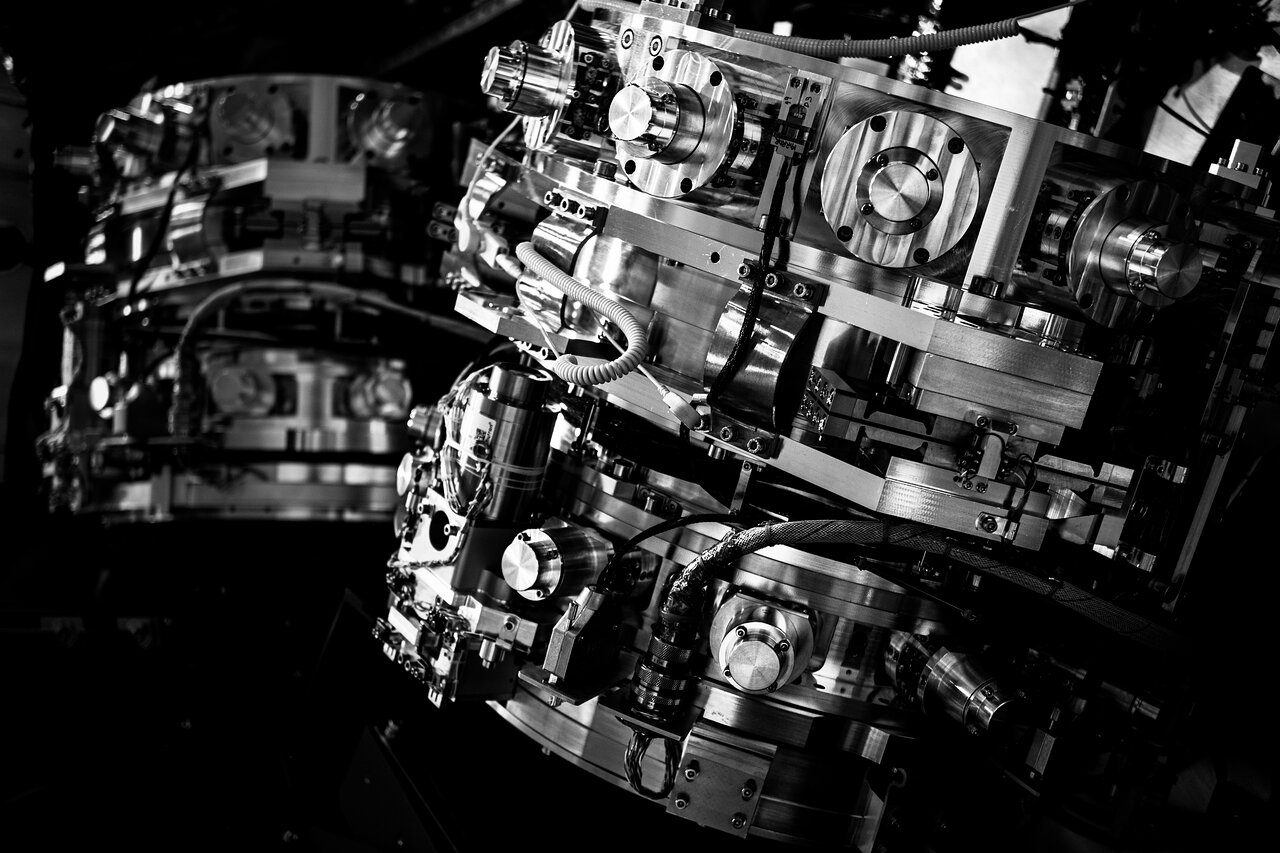
Two infrared cameras reveal the intricate engineering inside ESO’s MOONS instrument, designed to uncover hidden stars and trace how galaxies evolve.
| Active satellites | 16,687 |
| Catalogued objects | 32,084 |
| Starlink active | 9,902 |
Two infrared cameras inside MOONS will help astronomers investigate stars concealed behind the Milky Way’s dust. Suspended in darkness in this ESO image, their tiered metal structures, bolts and cables reveal the engineering behind a new instrument at the Very Large Telescope that has recently made its first observations.
MOONS stands for Multi Object Optical and Near-infrared Spectrograph. Infrared light (radiation at wavelengths longer than visible light) can penetrate dust that obscures the Galaxy’s inner stars, allowing astronomers to examine populations otherwise hidden from view.
Around 1000 fibre-optic cables, each guided by a robotic positioner, collect light from individual astronomical targets and feed it into two spectrographs. These instruments separate light into its constituent wavelengths, exposing chemical fingerprints that help researchers determine composition and velocity, and infer properties such as mass.
Cold detectors, a crowded sky
The cameras must distinguish faint astronomical infrared light from radiation emitted by their surroundings. A cryostat (a cooled enclosure) keeps MOONS between –143 and –233 degrees Celsius, reducing contamination from the instrument itself.
Its scientific reach extends from a three-dimensional map of the Milky Way’s centre to studies of millions of galaxies at different ages of the Universe. The connection is spectroscopy: decoding light to reconstruct how stars and galaxies formed and changed.
MOONS observes from the ground, rather than joining the spacecraft population overhead. Orbital Radar tracking data lists 16,687 active satellites in orbit as of 9 November 2026. Orbital Radar’s live catalogue contains 32,084 objects, including debris, as of 9 November 2026.
Those orbital figures describe a different observing challenge from the dust MOONS looks through: distinguishing objects moving around Earth from the distant sky. Readers exploring that distinction can use Orbital Radar’s Pass Predictor to find satellite passes, while MOONS examines the physical information carried by starlight.
Frequently Asked Questions
What does the MOONS image show?
How can MOONS study so many stars and galaxies?
Cite this article
Pick a style, then copy it or download it for your reference manager.Orbital Radar. (2026, November 9). New MOONS: the cold cameras that will probe hidden stars. Retrieved November 9, 2026, from https://orbitalradar.com/blog/cosmic-gallery-2026-11-09
“New MOONS: the cold cameras that will probe hidden stars.” Orbital Radar, 9 Nov. 2026, orbitalradar.com/blog/cosmic-gallery-2026-11-09. Accessed 9 Nov. 2026.
Orbital Radar (2026) New MOONS: the cold cameras that will probe hidden stars. Available at: https://orbitalradar.com/blog/cosmic-gallery-2026-11-09 (Accessed: 9 November 2026).
Orbital Radar. “New MOONS: the cold cameras that will probe hidden stars.” Last modified November 9, 2026. https://orbitalradar.com/blog/cosmic-gallery-2026-11-09.
@misc{orbitalradar_blog_cosmic_gallery_2026_11_09,
  author       = {{Orbital Radar}},
  title        = {New MOONS: the cold cameras that will probe hidden stars},
  year         = {2026},
  month        = nov,
  howpublished = {\url{https://orbitalradar.com/blog/cosmic-gallery-2026-11-09}},
  url          = {https://orbitalradar.com/blog/cosmic-gallery-2026-11-09},
  urldate      = {2026-11-09},
  note         = {Accessed 2026-11-09}
}
TY - ELEC AU - Orbital Radar, TI - New MOONS: the cold cameras that will probe hidden stars PY - 2026 DA - 2026/11/09 PB - Orbital Radar UR - https://orbitalradar.com/blog/cosmic-gallery-2026-11-09 Y2 - 2026/11/09 LA - en ER -
Live figures change, so keep the date you accessed the page. How to cite Orbital Radar