1976 Redux: A Double Rainbow Over Kitt Peak’s Telescopes
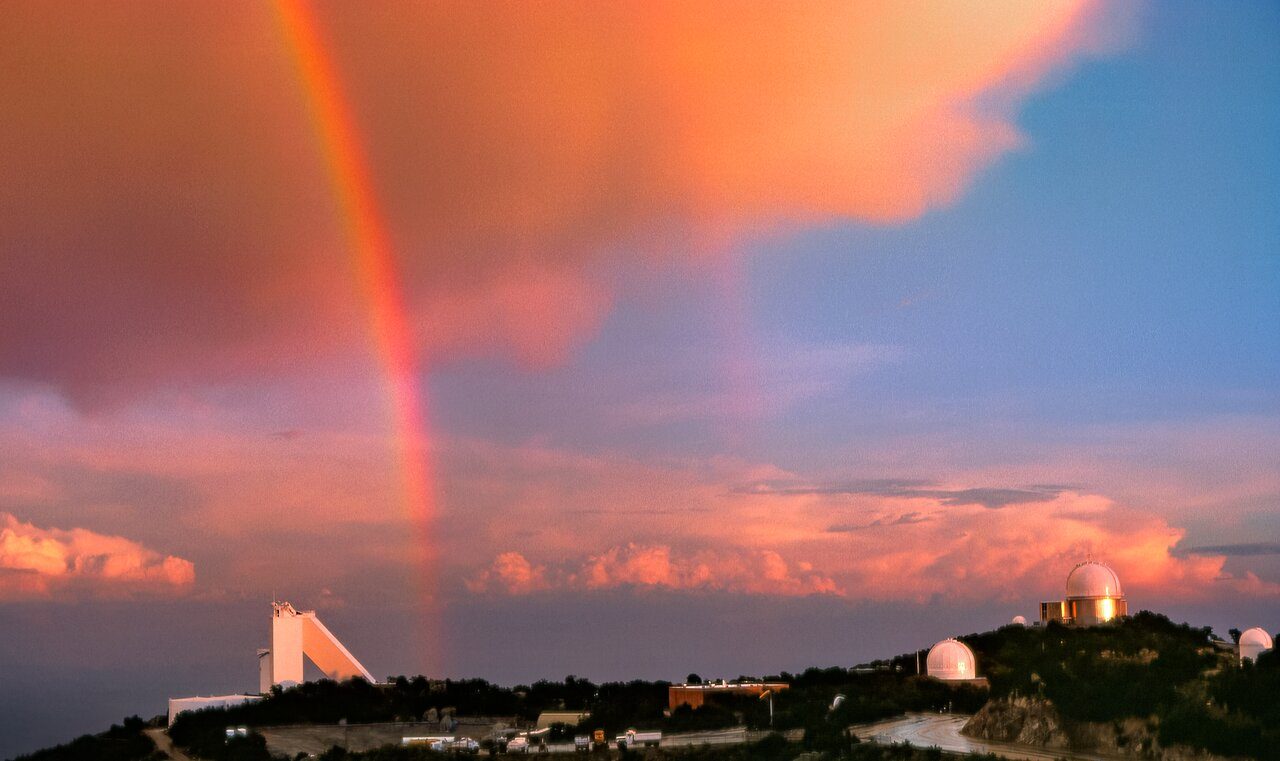
Carey Portnoy’s 1976 photograph frames Kitt Peak beneath a double rainbow — a natural counterpart to the instruments astronomers use to separate starlight.
| Active satellites | 16,686 |
| Catalogued objects | 32,092 |
| Starlink active | 9,891 |
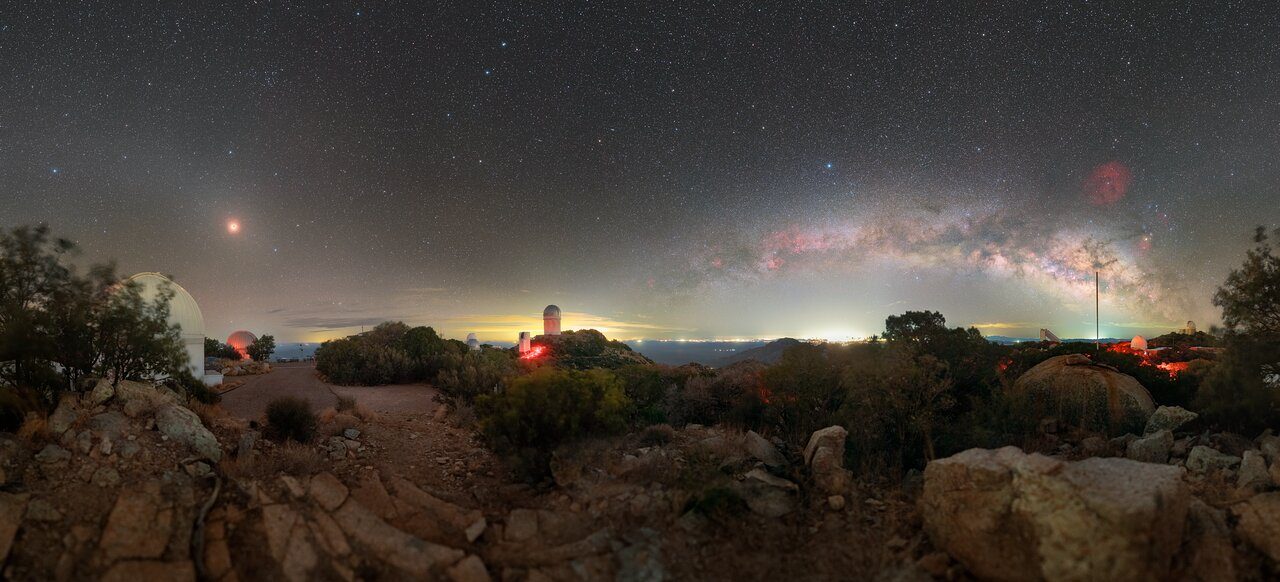
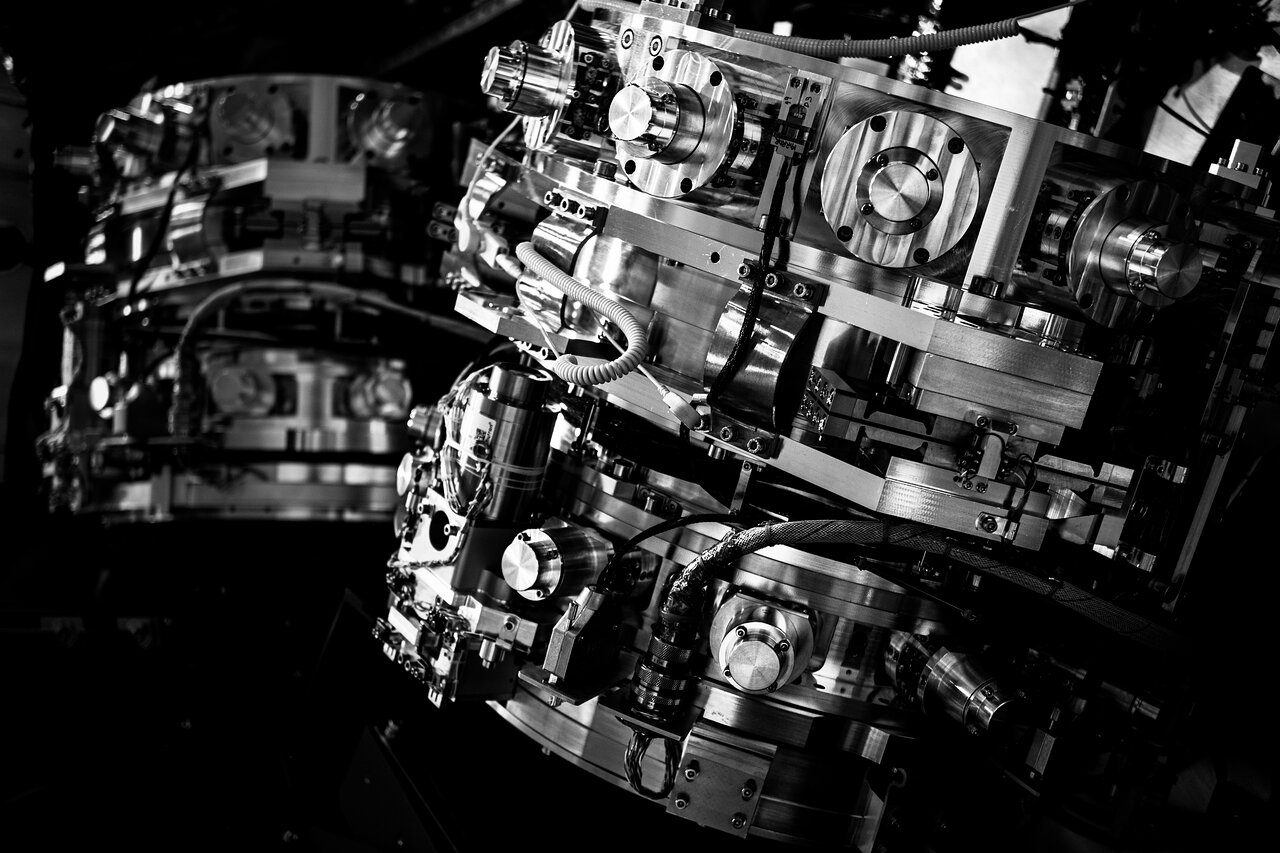
A double rainbow stretches over Kitt Peak National Observatory in Carey Portnoy’s photograph from 1976, bringing an atmospheric demonstration of light to a mountain devoted to studying it. Water droplets separate sunlight into colours; inside many of the observatory’s telescopes, spectrographs (instruments that separate light by wavelength) perform a related task with light from space.
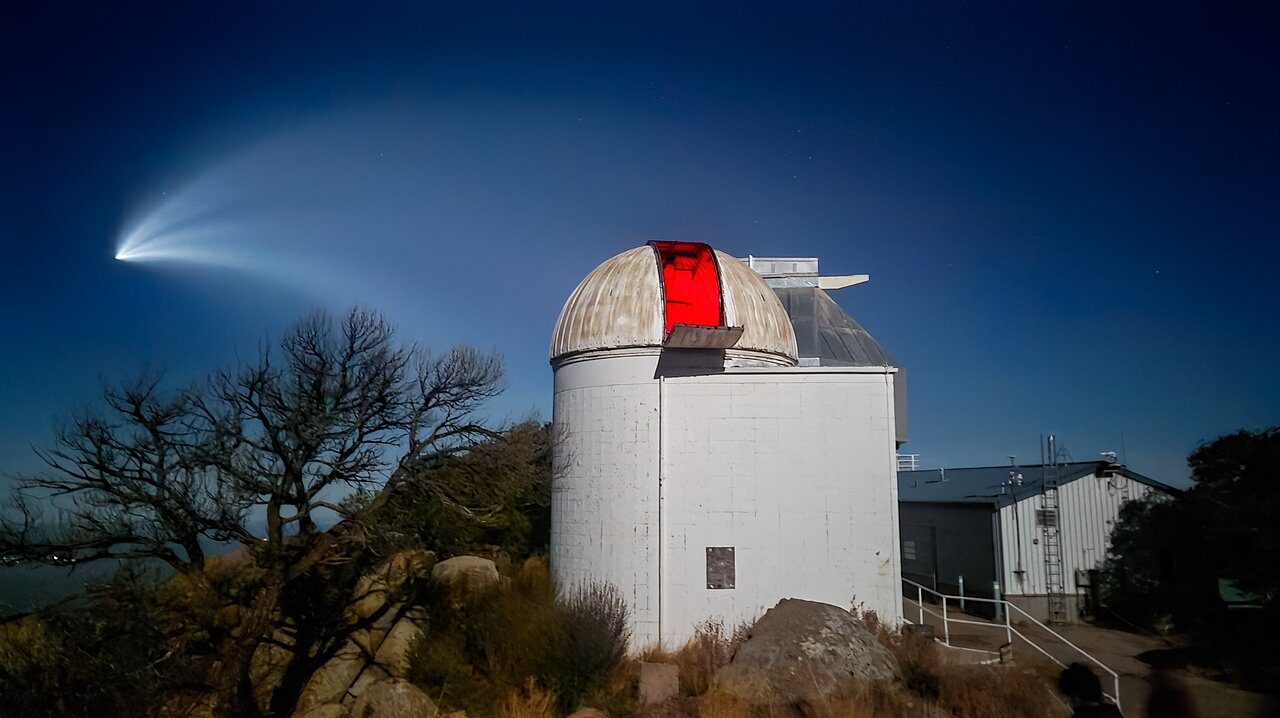
At the far left stands the distinctly shaped McMath-Pierce Solar Telescope, with a vacuum telescope tower behind it; both have since been decommissioned. The cafeteria occupies the centre, while rain-soaked roads, the Robotically Controlled Telescope and the glistening KPNO 2.1-metre telescope lie to its right. Portnoy, a former technical assistant at the observatory, captured a scene where everyday working spaces and astronomical instruments share the same weather.
From rainbow colours to astronomical evidence
A rainbow spreads sunlight into a visible spectrum, but astronomical spectroscopy reaches beyond what our eyes can see. By measuring light at different wavelengths, including infrared, astronomers can investigate an object’s composition, motion and distance. The former vacuum tower addressed another problem: its chamber, nearly the height of the building, stabilised the telescope’s internal environment to help produce crisp solar images.
Today, looking beyond Earth also means accounting for a substantial population of artificial objects. Orbital Radar tracking data records 16,686 active satellites in orbit as of 10 November 2026. Orbital Radar’s live catalogue contains 32,092 objects, including debris, as of 10 November 2026. For readers planning their own skywatching, the Orbital Radar Pass Predictor helps distinguish opportunities to watch satellites from the more distant targets studied by observatories. This photograph offers a complementary lesson: sometimes the physics that helps explain the universe is visible in the weather above a telescope.
Frequently Asked Questions
Who photographed the double rainbow over Kitt Peak?
How are Kitt Peak’s spectrographs related to a rainbow?
Cite this article
Pick a style, then copy it or download it for your reference manager.Orbital Radar. (2026, November 10). 1976 Redux: A Double Rainbow Over Kitt Peak’s Telescopes. Retrieved November 10, 2026, from https://orbitalradar.com/blog/cosmic-gallery-2026-11-10
“1976 Redux: A Double Rainbow Over Kitt Peak’s Telescopes.” Orbital Radar, 10 Nov. 2026, orbitalradar.com/blog/cosmic-gallery-2026-11-10. Accessed 10 Nov. 2026.
Orbital Radar (2026) 1976 Redux: A Double Rainbow Over Kitt Peak’s Telescopes. Available at: https://orbitalradar.com/blog/cosmic-gallery-2026-11-10 (Accessed: 10 November 2026).
Orbital Radar. “1976 Redux: A Double Rainbow Over Kitt Peak’s Telescopes.” Last modified November 10, 2026. https://orbitalradar.com/blog/cosmic-gallery-2026-11-10.
@misc{orbitalradar_blog_cosmic_gallery_2026_11_10,
  author       = {{Orbital Radar}},
  title        = {1976 Redux: A Double Rainbow Over Kitt Peak’s Telescopes},
  year         = {2026},
  month        = nov,
  howpublished = {\url{https://orbitalradar.com/blog/cosmic-gallery-2026-11-10}},
  url          = {https://orbitalradar.com/blog/cosmic-gallery-2026-11-10},
  urldate      = {2026-11-10},
  note         = {Accessed 2026-11-10}
}
TY - ELEC AU - Orbital Radar, TI - 1976 Redux: A Double Rainbow Over Kitt Peak’s Telescopes PY - 2026 DA - 2026/11/10 PB - Orbital Radar UR - https://orbitalradar.com/blog/cosmic-gallery-2026-11-10 Y2 - 2026/11/10 LA - en ER -
Live figures change, so keep the date you accessed the page. How to cite Orbital Radar