Tucson Twinkling at Twilight: A Distant Window on Kitt Peak

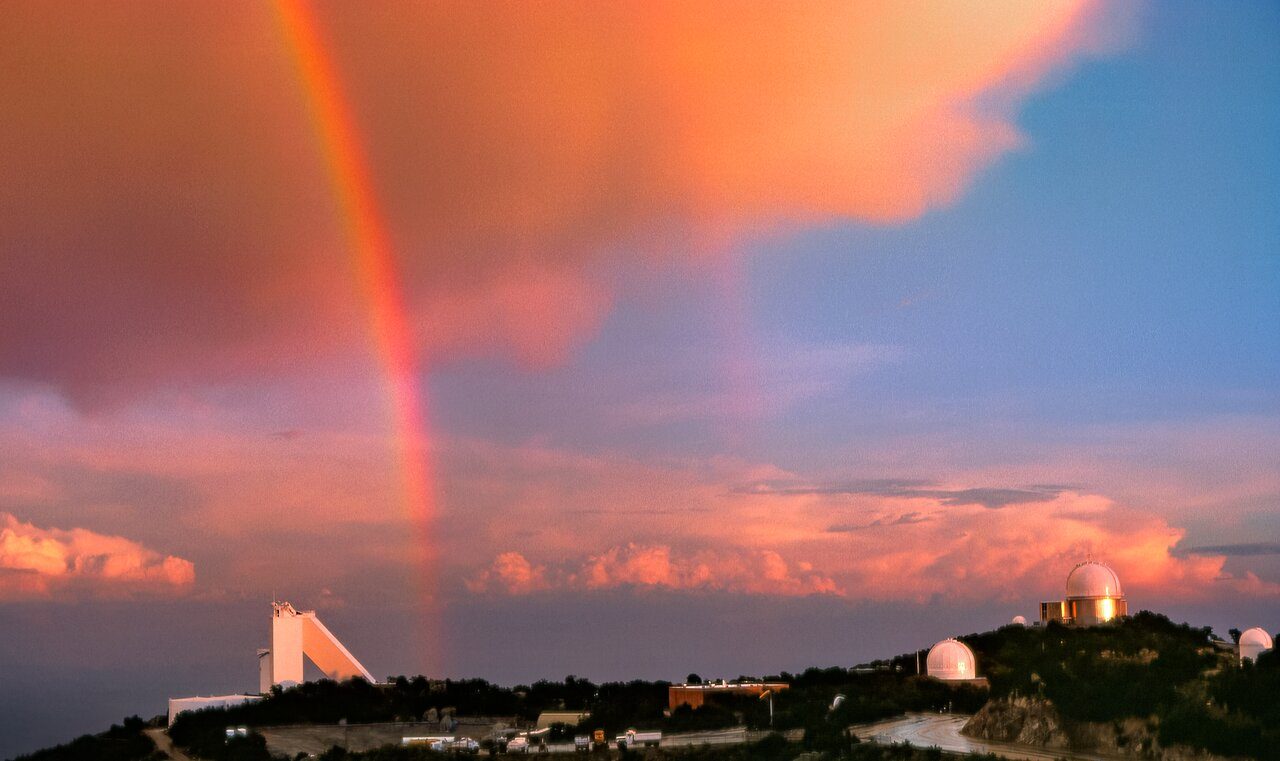
Seen from Windy Point Vista, Tucson’s twilight panorama reaches as far as Kitt Peak, where the Mayall telescope peeks above the Quinlan Mountains.
| Active satellites | 16,680 |
| Catalogued objects | 32,087 |
| Starlink active | 9,821 |
The Nicholas U. Mayall telescope peeks above the Quinlan Mountains at the far right of this twilight view of Tucson, photographed from about 60 miles away. NSF NOIRLab Audiovisual Ambassador Hernán Stockebrand captured the scene on 30 August 2026 from Windy Point Vista, beside the Catalina Highway.
The Mayall’s 4-metre designation describes the diameter of its main light-collecting mirror. A telescope gathers light from distant objects, allowing astronomers to study sources too faint for the unaided eye; here, the observatory itself becomes a distant subject in a much wider landscape.
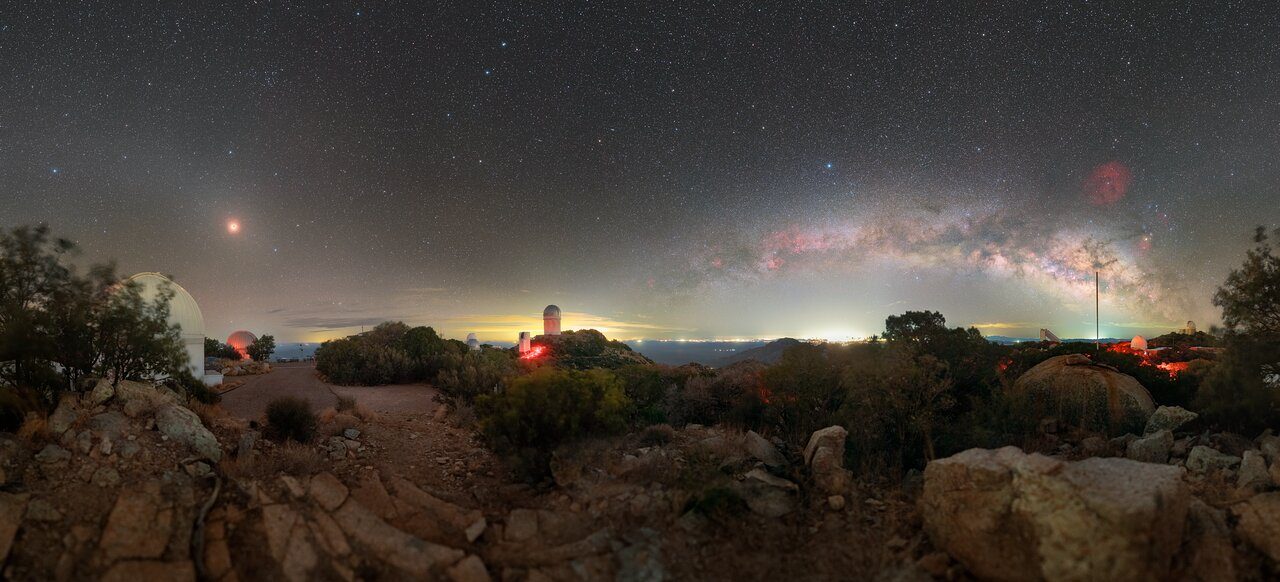
The setting also tells an ecological story. Mount Lemmon and Kitt Peak are “Sky Islands”: isolated mountains whose cooler environments support plants and animals distinct from those of the surrounding desert. On the ascent up Kitt Peak, the Sonoran Desert’s cacti give way to trees, bushes and grass.
A twilight landscape beneath an occupied sky
Twilight connects this terrestrial scene to orbital astronomy. After sunset, sunlight scattered by Earth’s atmosphere still illuminates the sky, while satellites overhead can remain sunlit even when an observer below is in darkness. Their visibility depends on the geometry between the Sun, spacecraft and observer; this does not mean a satellite is identifiable in this photograph.
Orbital Radar tracking data lists 16,680 active satellites in orbit as of 14 November 2026. Orbital Radar tracking data lists 9,821 operational Starlink satellites as of 14 November 2026.
For observers planning their own evening above Tucson, Orbital Radar’s Pass Predictor helps distinguish opportunities to watch orbiting spacecraft from the more patient business of observing distant celestial objects. This photograph offers a different pleasure: finding a working astronomical observatory within the landscape that surrounds it.
Frequently Asked Questions
Where was Tucson Twinkling at Twilight photographed?
Which telescope is visible above the mountains?
Cite this article
Pick a style, then copy it or download it for your reference manager.Orbital Radar. (2026, November 14). Tucson Twinkling at Twilight: A Distant Window on Kitt Peak. Retrieved November 14, 2026, from https://orbitalradar.com/blog/cosmic-gallery-2026-11-14
“Tucson Twinkling at Twilight: A Distant Window on Kitt Peak.” Orbital Radar, 14 Nov. 2026, orbitalradar.com/blog/cosmic-gallery-2026-11-14. Accessed 14 Nov. 2026.
Orbital Radar (2026) Tucson Twinkling at Twilight: A Distant Window on Kitt Peak. Available at: https://orbitalradar.com/blog/cosmic-gallery-2026-11-14 (Accessed: 14 November 2026).
Orbital Radar. “Tucson Twinkling at Twilight: A Distant Window on Kitt Peak.” Last modified November 14, 2026. https://orbitalradar.com/blog/cosmic-gallery-2026-11-14.
@misc{orbitalradar_blog_cosmic_gallery_2026_11_14,
  author       = {{Orbital Radar}},
  title        = {Tucson Twinkling at Twilight: A Distant Window on Kitt Peak},
  year         = {2026},
  month        = nov,
  howpublished = {\url{https://orbitalradar.com/blog/cosmic-gallery-2026-11-14}},
  url          = {https://orbitalradar.com/blog/cosmic-gallery-2026-11-14},
  urldate      = {2026-11-14},
  note         = {Accessed 2026-11-14}
}
TY - ELEC AU - Orbital Radar, TI - Tucson Twinkling at Twilight: A Distant Window on Kitt Peak PY - 2026 DA - 2026/11/14 PB - Orbital Radar UR - https://orbitalradar.com/blog/cosmic-gallery-2026-11-14 Y2 - 2026/11/14 LA - en ER -
Live figures change, so keep the date you accessed the page. How to cite Orbital Radar