65 million light-years away, Webb traces a stellar lifecycle
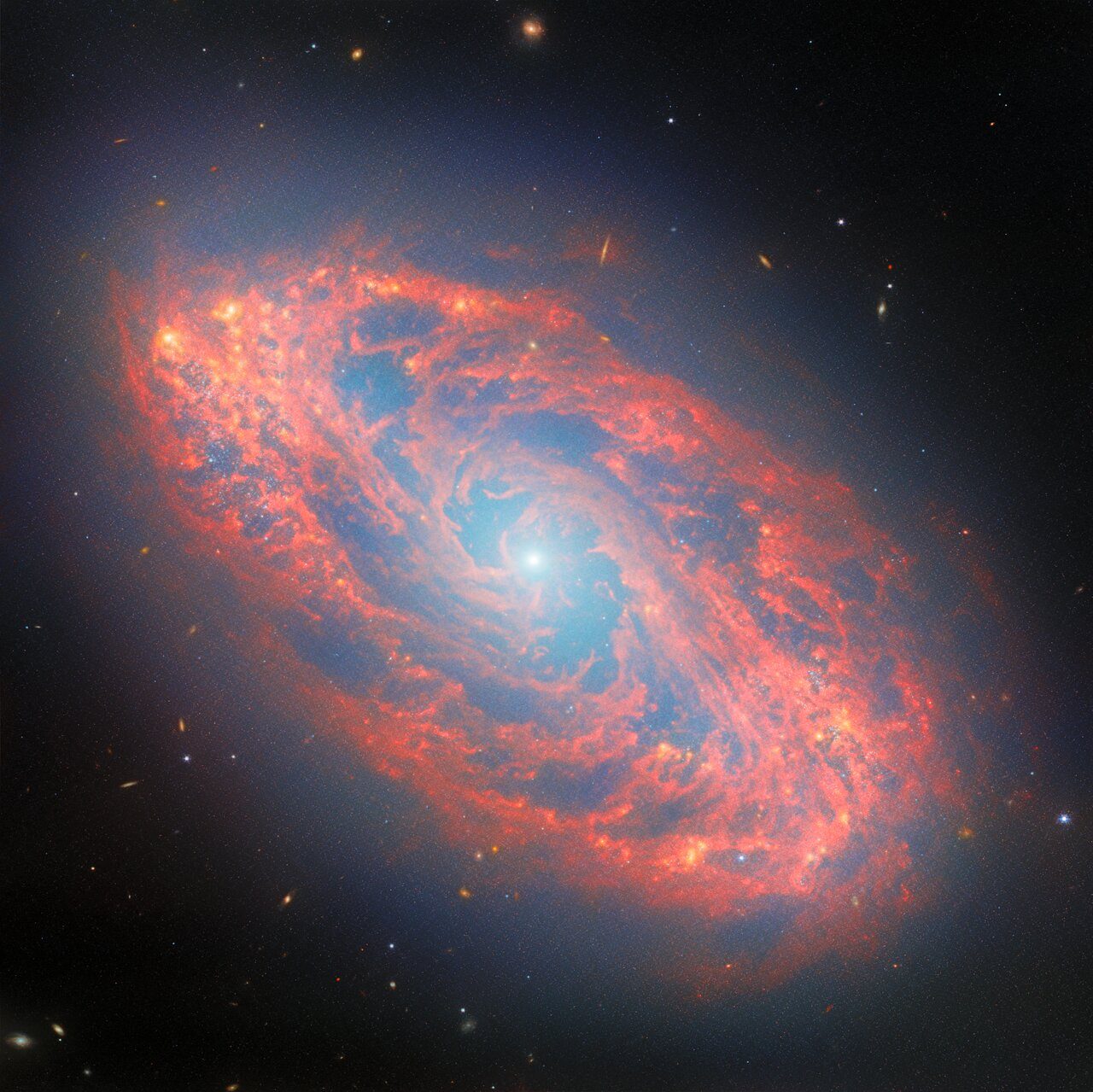
Webb's view of NGC 5134 brings stars and dusty gas into focus, revealing the ingredients of a continuing cycle of stellar birth, death and renewal.
| Active satellites | 16,690 |
| Catalogued objects | 32,115 |
| Starlink active | 9,870 |
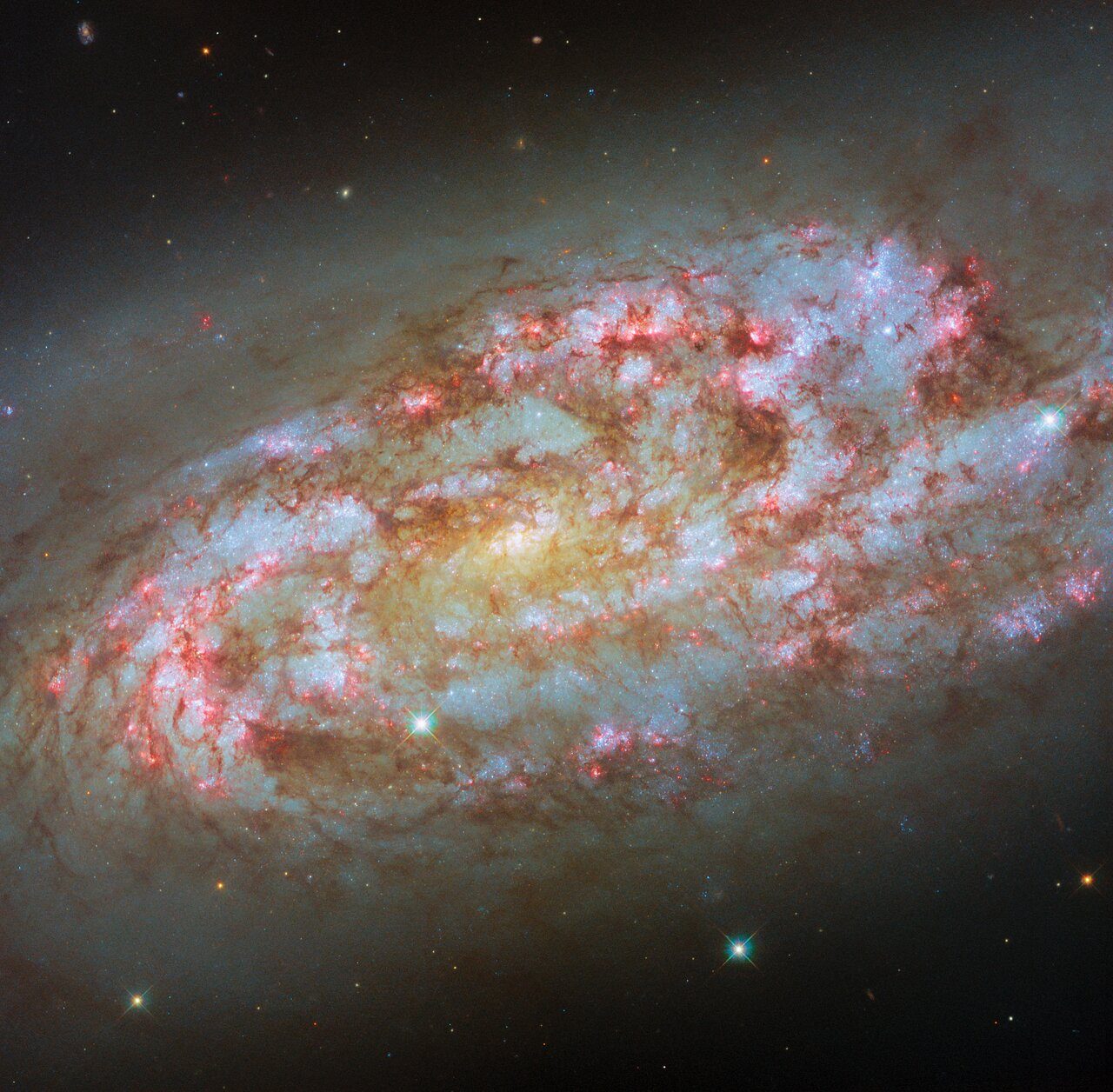
The James Webb Space Telescope has brought the ingredients of stellar renewal into focus in NGC 5134, a spiral galaxy 65 million light-years away in Virgo. Its tightly wound arms contain dusty gas clouds, stars and star clusters: different stages of a cycle that continually reshapes the galaxy.
Two instruments reveal complementary parts of that scene. The Mid-Infrared Instrument (MIRI) detects light emitted by warm dust, tracing clumps and strands within interstellar clouds (clouds of material between stars). The Near-Infrared Camera (NIRCam) records shorter-wavelength infrared light, mostly from stars and star clusters.
Some of the dust contains polycyclic aromatic hydrocarbons, complex organic molecules built from interconnected carbon rings. Their emission helps astronomers investigate the chemistry of the clouds where stars form.
How a galaxy replenishes its stellar nursery
Star formation draws down a galaxy's gas reserves, but dying stars return some material to space. Stars more than about eight times the Sun's mass can scatter material through supernova explosions, while Sun-like stars shed their outer atmospheres more gently after becoming red giants.
These observations belong to programme 3707, which studies 55 nearby, actively star-forming galaxies. By examining individual clusters and clouds, astronomers can investigate how young stars reshape their surroundings and how dust grains evolve.
Nearby galaxies provide a detailed reference for interpreting much more distant systems. The faint background galaxies in this image illustrate that observational gap: objects barely distinguishable as points of light can contain stellar populations and gas cycles of their own.
Putting the view in perspective
Orbital Radar tracking data records 16,690 active satellites as of 11 November 2026. Webb's image offers a different perspective on space activity: an observatory investigating processes far beyond Earth's satellite population.
Orbital Radar tracking data records 10 people in space as of 11 November 2026. For background on the science behind robotic observatories and human spaceflight, Orbital Radar's Space Academy provides a starting point.
Frequently Asked Questions
How far away is NGC 5134?
What do Webb's instruments reveal in NGC 5134?
Cite this article
Pick a style, then copy it or download it for your reference manager.Orbital Radar. (2026, November 11). 65 million light-years away, Webb traces a stellar lifecycle. Retrieved November 11, 2026, from https://orbitalradar.com/blog/cosmic-gallery-2026-11-11
“65 million light-years away, Webb traces a stellar lifecycle.” Orbital Radar, 11 Nov. 2026, orbitalradar.com/blog/cosmic-gallery-2026-11-11. Accessed 11 Nov. 2026.
Orbital Radar (2026) 65 million light-years away, Webb traces a stellar lifecycle. Available at: https://orbitalradar.com/blog/cosmic-gallery-2026-11-11 (Accessed: 11 November 2026).
Orbital Radar. “65 million light-years away, Webb traces a stellar lifecycle.” Last modified November 11, 2026. https://orbitalradar.com/blog/cosmic-gallery-2026-11-11.
@misc{orbitalradar_blog_cosmic_gallery_2026_11_11,
  author       = {{Orbital Radar}},
  title        = {65 million light-years away, Webb traces a stellar lifecycle},
  year         = {2026},
  month        = nov,
  howpublished = {\url{https://orbitalradar.com/blog/cosmic-gallery-2026-11-11}},
  url          = {https://orbitalradar.com/blog/cosmic-gallery-2026-11-11},
  urldate      = {2026-11-11},
  note         = {Accessed 2026-11-11}
}
TY - ELEC AU - Orbital Radar, TI - 65 million light-years away, Webb traces a stellar lifecycle PY - 2026 DA - 2026/11/11 PB - Orbital Radar UR - https://orbitalradar.com/blog/cosmic-gallery-2026-11-11 Y2 - 2026/11/11 LA - en ER -
Live figures change, so keep the date you accessed the page. How to cite Orbital Radar