Let’s Go, Airglow: Why Orange Light Fills Hawai‘i’s Sky
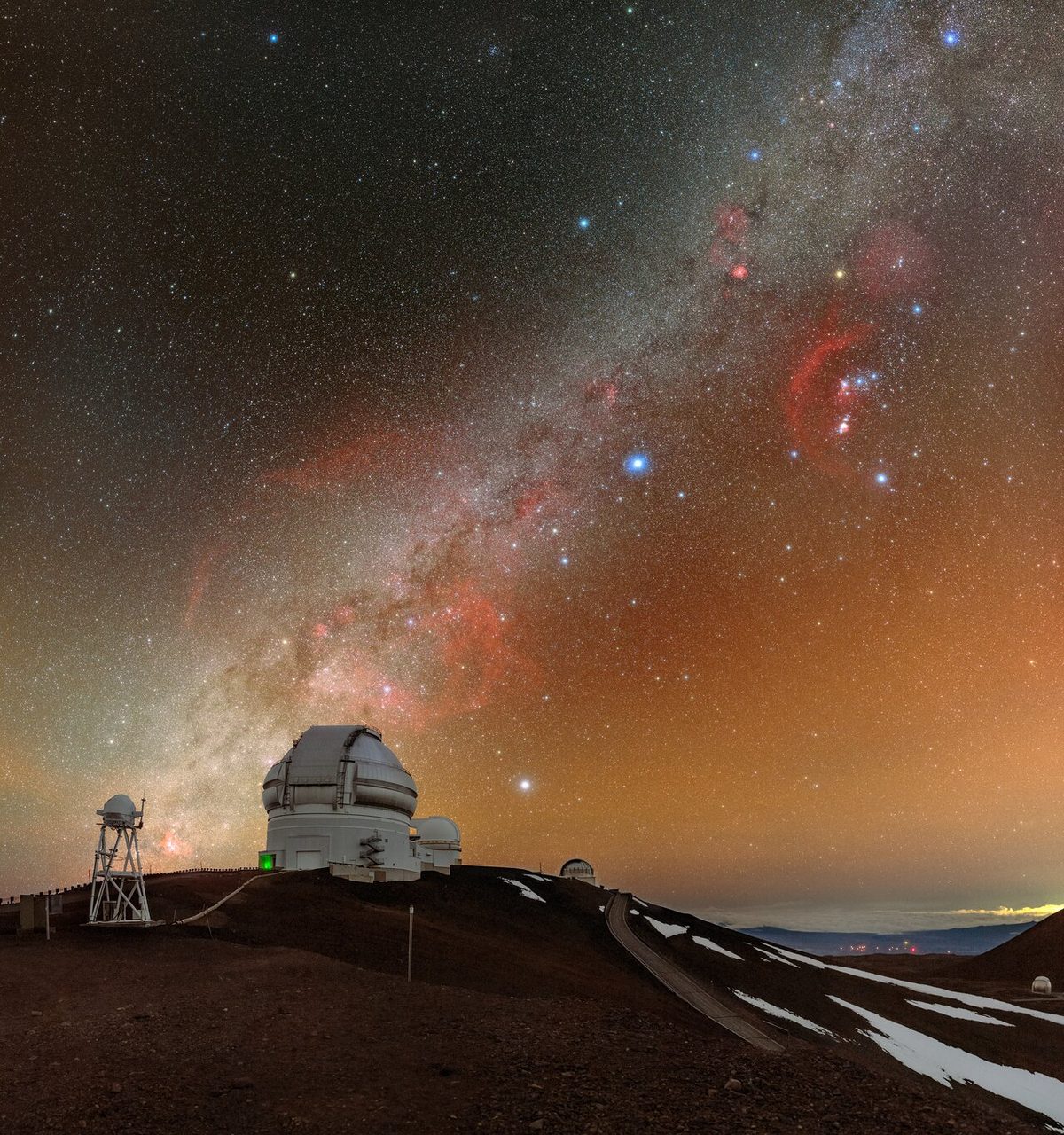
Orange airglow washes over Gemini North in Hawai‘i, sharing the sky with Orion’s red nebulae. The scene brings atmospheric chemistry and distant star-forming clouds into view.
| Active satellites | 16,693 |
| Catalogued objects | 32,153 |
| Starlink active | 9,810 |
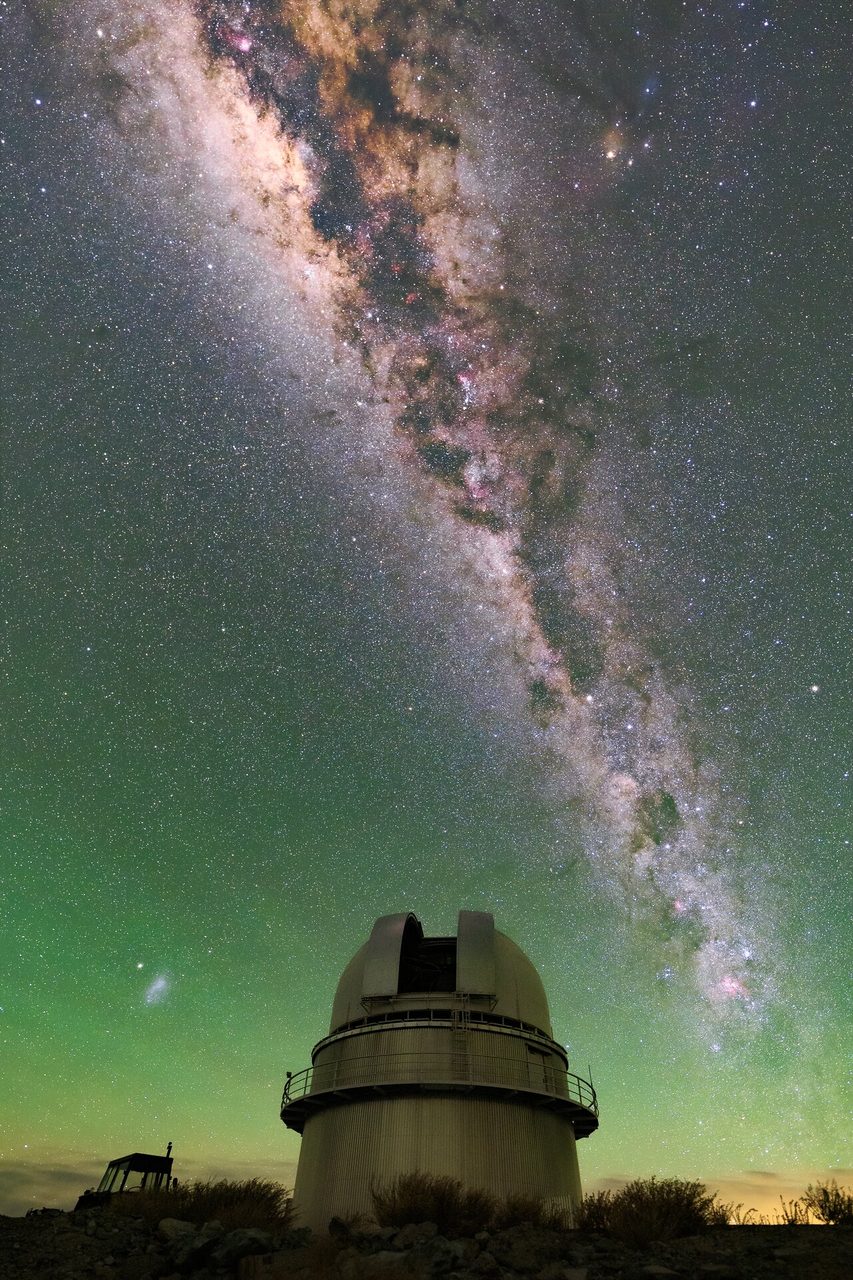
The orange glow above Gemini North in Hawai‘i comes from Earth’s own atmosphere, not the distant stars beyond it. In this photograph, made during the NOIRLab 2022 Photo Expedition, airglow shares the sky with Orion’s red emission nebulae and Sirius, the brightest star in the night sky.
Airglow is light released by atoms and molecules in the atmosphere after they have gained energy from sunlight during the day. The orange light described here comes from sodium in a layer about 80–105 km above sea level. Its colour reveals the emitting material: a clue to atmospheric chemistry written across the night sky.
Orion appears at the upper right, with the Orion Nebula in its sword, Barnard’s Loop around its lower half and the faint Lambda Orionis Ring surrounding its head. To the left lies Canis Major, containing Sirius; farther left, above Gemini North, is the Gum Nebula. These emission nebulae (clouds of gas that give off light) belong to a very different physical setting from the glowing atmosphere in the foreground.
Reading a sky shared with satellites
The photograph illustrates why a dark observing site does not mean a completely dark sky: Earth produces a natural luminous foreground. Satellite trails are a separate feature observers may encounter, distinct from both diffuse airglow and distant nebulae.
Orbital Radar tracking data lists 16,693 active satellites in orbit in 2026. Orbital Radar tracking data lists 9,810 active Starlink satellites in 2026.
Those figures describe the wider orbital environment, not objects identified in this photograph. For your own observing session, the Orbital Radar Pass Predictor can help you anticipate visible satellite passes while you explore Orion and the atmosphere’s quieter glow.
Frequently Asked Questions
What causes the orange airglow above Gemini North?
Which Orion nebulae are visible in the photograph?
Cite this article
Pick a style, then copy it or download it for your reference manager.Orbital Radar. (2026, November 18). Let’s Go, Airglow: Why Orange Light Fills Hawai‘i’s Sky. Retrieved November 18, 2026, from https://orbitalradar.com/blog/cosmic-gallery-2026-11-18
“Let’s Go, Airglow: Why Orange Light Fills Hawai‘i’s Sky.” Orbital Radar, 18 Nov. 2026, orbitalradar.com/blog/cosmic-gallery-2026-11-18. Accessed 18 Nov. 2026.
Orbital Radar (2026) Let’s Go, Airglow: Why Orange Light Fills Hawai‘i’s Sky. Available at: https://orbitalradar.com/blog/cosmic-gallery-2026-11-18 (Accessed: 18 November 2026).
Orbital Radar. “Let’s Go, Airglow: Why Orange Light Fills Hawai‘i’s Sky.” Last modified November 18, 2026. https://orbitalradar.com/blog/cosmic-gallery-2026-11-18.
@misc{orbitalradar_blog_cosmic_gallery_2026_11_18,
  author       = {{Orbital Radar}},
  title        = {Let’s Go, Airglow: Why Orange Light Fills Hawai‘i’s Sky},
  year         = {2026},
  month        = nov,
  howpublished = {\url{https://orbitalradar.com/blog/cosmic-gallery-2026-11-18}},
  url          = {https://orbitalradar.com/blog/cosmic-gallery-2026-11-18},
  urldate      = {2026-11-18},
  note         = {Accessed 2026-11-18}
}
TY - ELEC AU - Orbital Radar, TI - Let’s Go, Airglow: Why Orange Light Fills Hawai‘i’s Sky PY - 2026 DA - 2026/11/18 PB - Orbital Radar UR - https://orbitalradar.com/blog/cosmic-gallery-2026-11-18 Y2 - 2026/11/18 LA - en ER -
Live figures change, so keep the date you accessed the page. How to cite Orbital Radar