Early risers: a crescent Moon meets Venus over the Andes
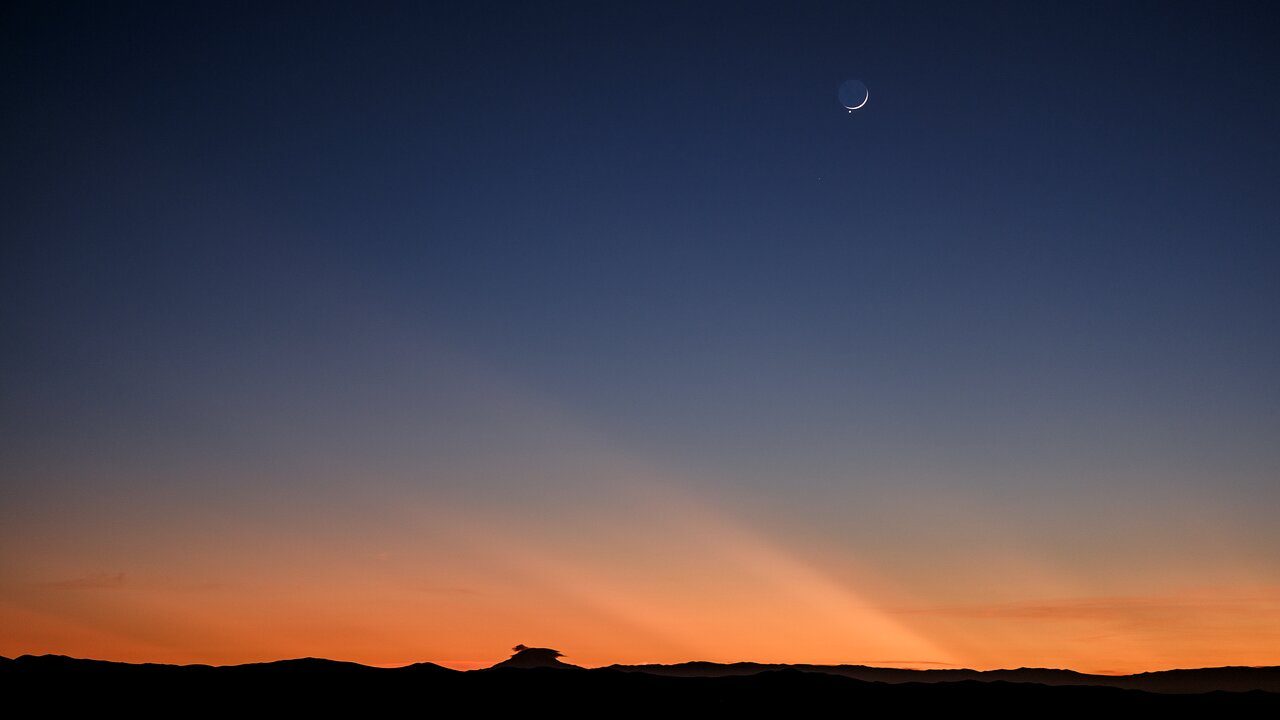
A thin crescent Moon and brilliant Venus appear almost to touch above the Andes. ESO’s dawn photograph captures an alignment shaped by sunlight and perspective.
| Active satellites | 16,693 |
| Catalogued objects | 32,125 |
| Starlink active | 9,813 |
A thin crescent Moon and Venus appear almost to touch above the Andes in this dawn photograph taken on 7 November from ESO’s Paranal Observatory in Chile. Beneath them, Llullaillaco volcano rises more than 6,700 metres above sea level, wearing a small cap of clouds about 190 kilometres from the observatory.
ESO astronomer Luca Sbordone spotted the pairing after a night of observations in the control room of the Very Large Telescope. After stopping for photographs on his drive down, he returned to the telescope platform as the Sun broke over the horizon. The apparent meeting is a conjunction (a close alignment on the sky), not a physical encounter: Venus was some 45 million kilometres from Earth that morning, more than 100 times farther away than the Moon.
Two crescents, one viewing geometry
Through a telescope, Venus would also have shown a crescent, although its shape was too small to distinguish with the naked eye. Both worlds lay roughly between Earth and the Sun, presenting mostly their unlit sides towards the observer. Only a narrow edge of each sunlit half faced Earth; their apparent closeness concealed very different distances.
These natural worlds now share our skies with a substantial artificial population. Orbital Radar tracking data lists 16,693 active satellites in orbit as of November 2026. Starlink accounts for 9,813 active satellites as of November 2026, according to Orbital Radar tracking data.
Those spacecraft are a separate observing subject from this planetary pairing. For exploring the Moon itself, Orbital Radar’s Moon Globe shows its current position and phase, helping connect a crescent seen above the horizon with the changing geometry of sunlight.
Frequently Asked Questions
Why do the Moon and Venus look so close in this photograph?
Was Venus also a crescent beside the Moon?
Cite this article
Pick a style, then copy it or download it for your reference manager.Orbital Radar. (2026, November 17). Early risers: a crescent Moon meets Venus over the Andes. Retrieved November 17, 2026, from https://orbitalradar.com/blog/cosmic-gallery-2026-11-17
“Early risers: a crescent Moon meets Venus over the Andes.” Orbital Radar, 17 Nov. 2026, orbitalradar.com/blog/cosmic-gallery-2026-11-17. Accessed 17 Nov. 2026.
Orbital Radar (2026) Early risers: a crescent Moon meets Venus over the Andes. Available at: https://orbitalradar.com/blog/cosmic-gallery-2026-11-17 (Accessed: 17 November 2026).
Orbital Radar. “Early risers: a crescent Moon meets Venus over the Andes.” Last modified November 17, 2026. https://orbitalradar.com/blog/cosmic-gallery-2026-11-17.
@misc{orbitalradar_blog_cosmic_gallery_2026_11_17,
  author       = {{Orbital Radar}},
  title        = {Early risers: a crescent Moon meets Venus over the Andes},
  year         = {2026},
  month        = nov,
  howpublished = {\url{https://orbitalradar.com/blog/cosmic-gallery-2026-11-17}},
  url          = {https://orbitalradar.com/blog/cosmic-gallery-2026-11-17},
  urldate      = {2026-11-17},
  note         = {Accessed 2026-11-17}
}
TY - ELEC AU - Orbital Radar, TI - Early risers: a crescent Moon meets Venus over the Andes PY - 2026 DA - 2026/11/17 PB - Orbital Radar UR - https://orbitalradar.com/blog/cosmic-gallery-2026-11-17 Y2 - 2026/11/17 LA - en ER -
Live figures change, so keep the date you accessed the page. How to cite Orbital Radar