A celebrity cluster bends distant galaxies into the spotlight
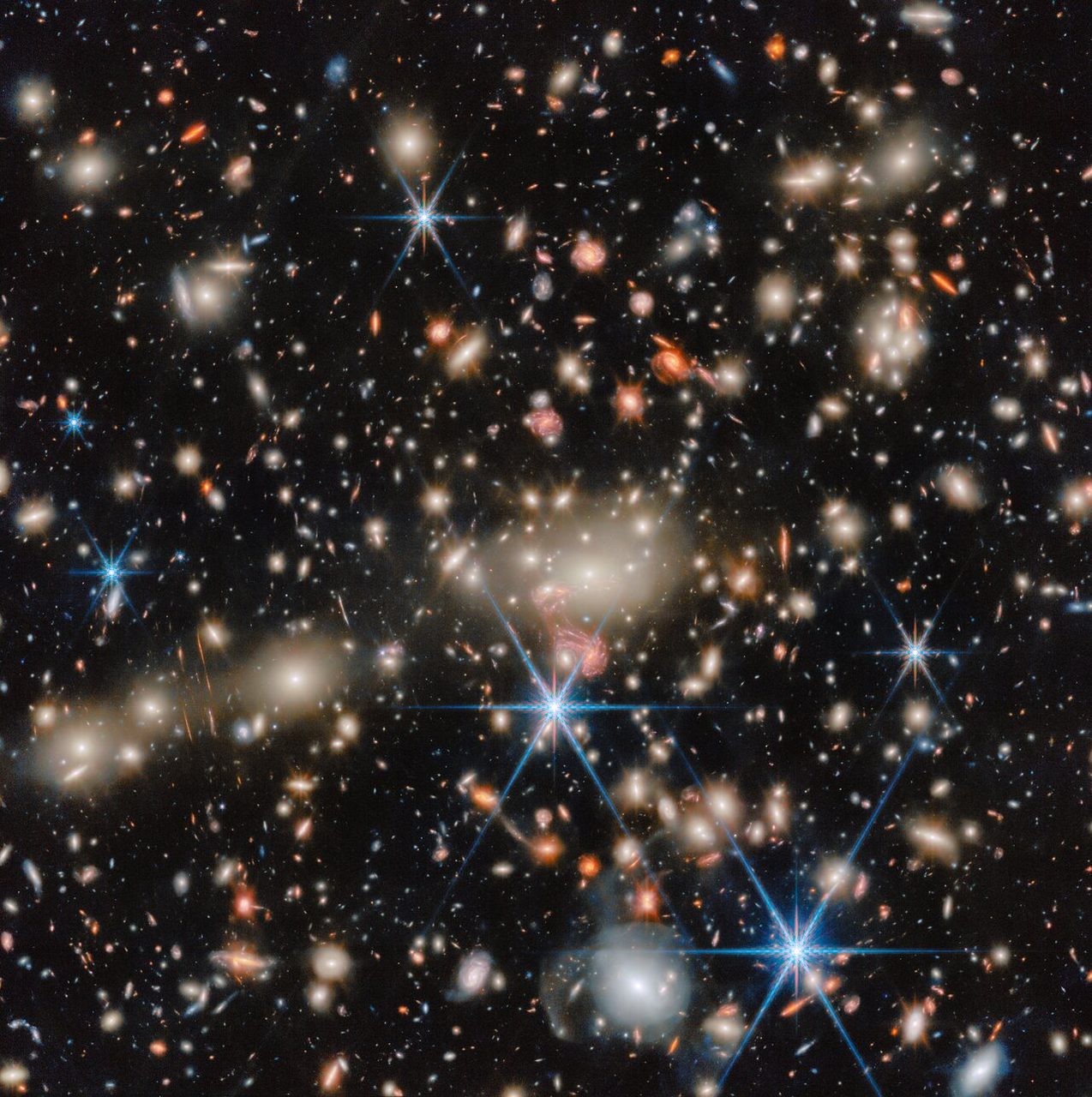
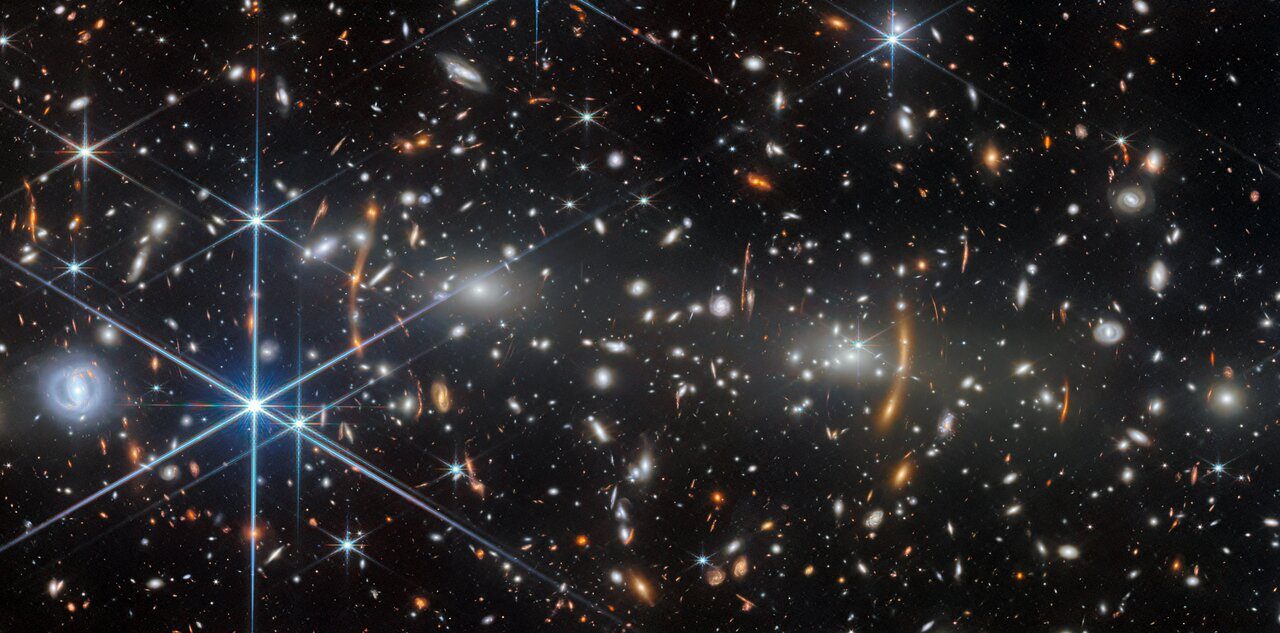
About 5 billion light-years away, galaxy cluster MACS J1149 bends the light of galaxies behind it. Webb’s view reveals how gravity turns a cluster into a cosmic lens.
| Active satellites | 16,681 |
| Catalogued objects | 32,100 |
| Starlink active | 9,821 |
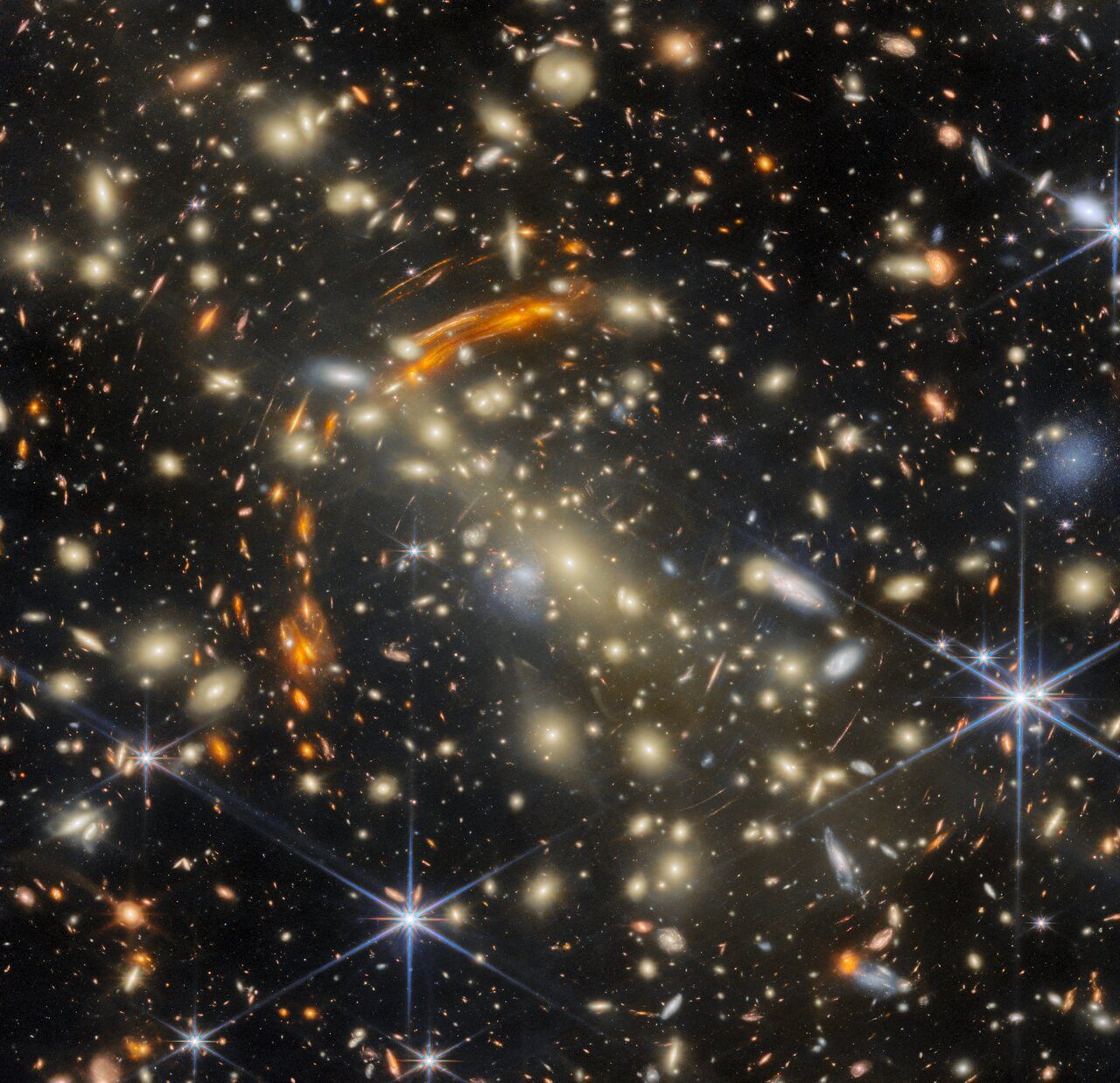
A galaxy stretched into something resembling a pink jellyfish reveals the power of gravity in this James Webb Space Telescope view of MACS J1149.5+2223. About 5 billion light-years away in Leo, the cluster contains more than 300 confirmed member galaxies, with several hundred more possible members.
The pale elliptical galaxies gathered at its centre help create gravitational lensing (the bending of light by intervening mass). Light from galaxies behind the cluster follows curved paths through spacetime, producing the narrow streaks and distorted shapes scattered across the image.
Just below the brilliant white central galaxies, the pink, distorted spiral offers a particularly revealing example. It hosts what was once the most distant individual star discovered, alongside a supernova whose image appeared four times at once: multiple views of the same stellar explosion, created by the intervening lens.
A natural telescope for the early Universe
MACS J1149 was one of six clusters studied by Hubble’s Frontier Fields programme, selected for their strong gravitational lensing. Such clusters let astronomers examine background galaxies that would otherwise be harder to study.
The Webb observations used here belong to the CAnadian NIRISS Unbiased Cluster Survey, or CANUCS, programme 1208. Researchers use Webb’s infrared instruments to investigate low-mass galaxies, tracing their star formation, dust and chemistry. The work also probes reionisation (the era when radiation from early stars and galaxies ionised the Universe’s hydrogen).
From distant galaxies to our orbital neighbourhood
Orbital Radar tracking data records 16,681 active satellites as of 15 November 2026. That nearby population is a different subject from the distant galaxies Webb studies: satellites orbit Earth, while MACS J1149 is a gravitationally bound assembly of galaxies.
Orbital Radar’s live catalogue contains 32,100 objects, including debris, as of 15 November 2026. For readers exploring the distinction between spacecraft, orbits and astronomical objects, the Orbital Radar glossary provides a useful companion to this view.
Frequently Asked Questions
How far away is galaxy cluster MACS J1149?
Why do galaxies look distorted in Webb’s MACS J1149 image?
Cite this article
Pick a style, then copy it or download it for your reference manager.Orbital Radar. (2026, November 15). A celebrity cluster bends distant galaxies into the spotlight. Retrieved November 15, 2026, from https://orbitalradar.com/blog/cosmic-gallery-2026-11-15
“A celebrity cluster bends distant galaxies into the spotlight.” Orbital Radar, 15 Nov. 2026, orbitalradar.com/blog/cosmic-gallery-2026-11-15. Accessed 15 Nov. 2026.
Orbital Radar (2026) A celebrity cluster bends distant galaxies into the spotlight. Available at: https://orbitalradar.com/blog/cosmic-gallery-2026-11-15 (Accessed: 15 November 2026).
Orbital Radar. “A celebrity cluster bends distant galaxies into the spotlight.” Last modified November 15, 2026. https://orbitalradar.com/blog/cosmic-gallery-2026-11-15.
@misc{orbitalradar_blog_cosmic_gallery_2026_11_15,
  author       = {{Orbital Radar}},
  title        = {A celebrity cluster bends distant galaxies into the spotlight},
  year         = {2026},
  month        = nov,
  howpublished = {\url{https://orbitalradar.com/blog/cosmic-gallery-2026-11-15}},
  url          = {https://orbitalradar.com/blog/cosmic-gallery-2026-11-15},
  urldate      = {2026-11-15},
  note         = {Accessed 2026-11-15}
}
TY - ELEC AU - Orbital Radar, TI - A celebrity cluster bends distant galaxies into the spotlight PY - 2026 DA - 2026/11/15 PB - Orbital Radar UR - https://orbitalradar.com/blog/cosmic-gallery-2026-11-15 Y2 - 2026/11/15 LA - en ER -
Live figures change, so keep the date you accessed the page. How to cite Orbital Radar