NGC 7129: Webb Reveals Young Stars Sculpting Their Nursery
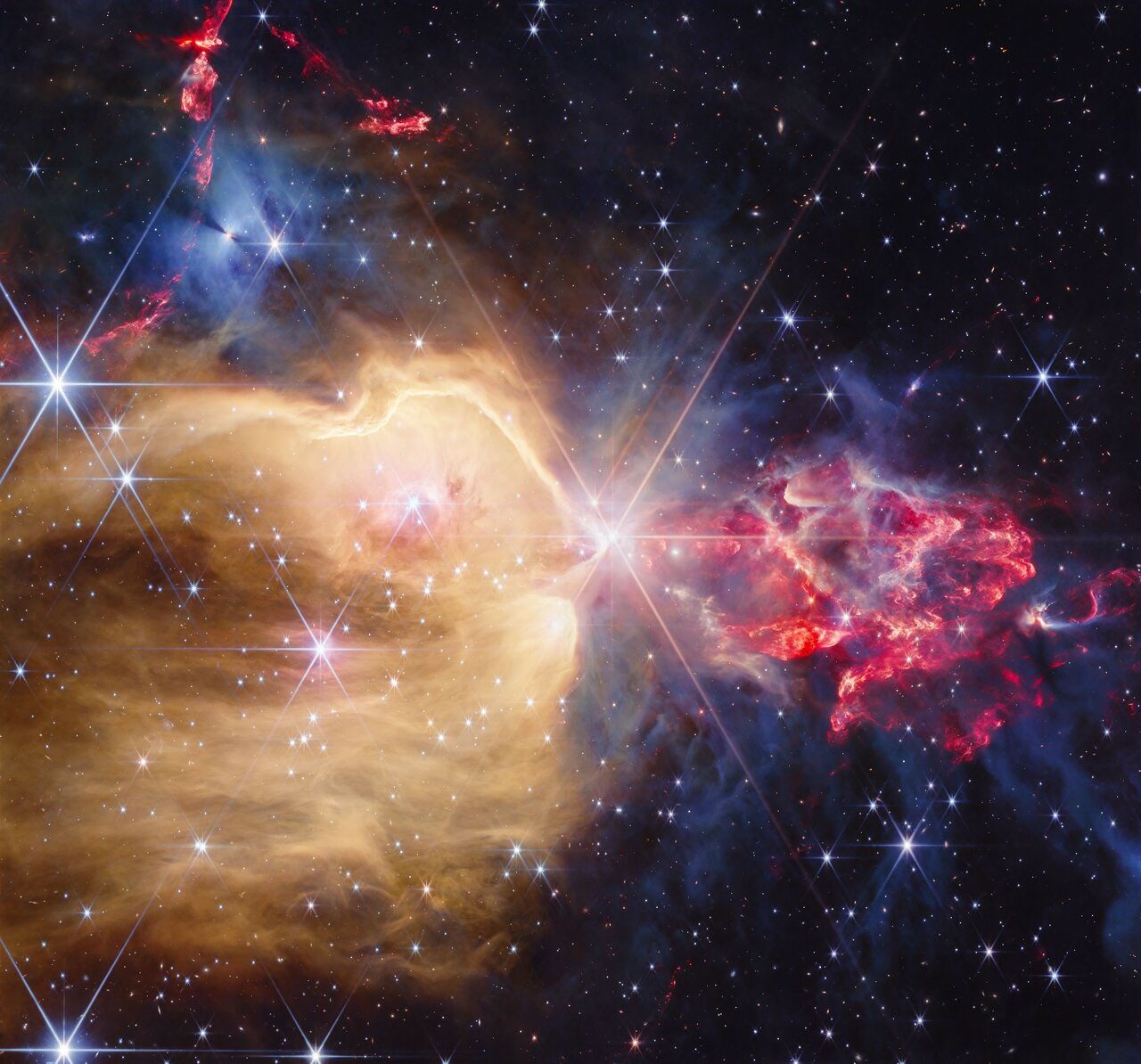
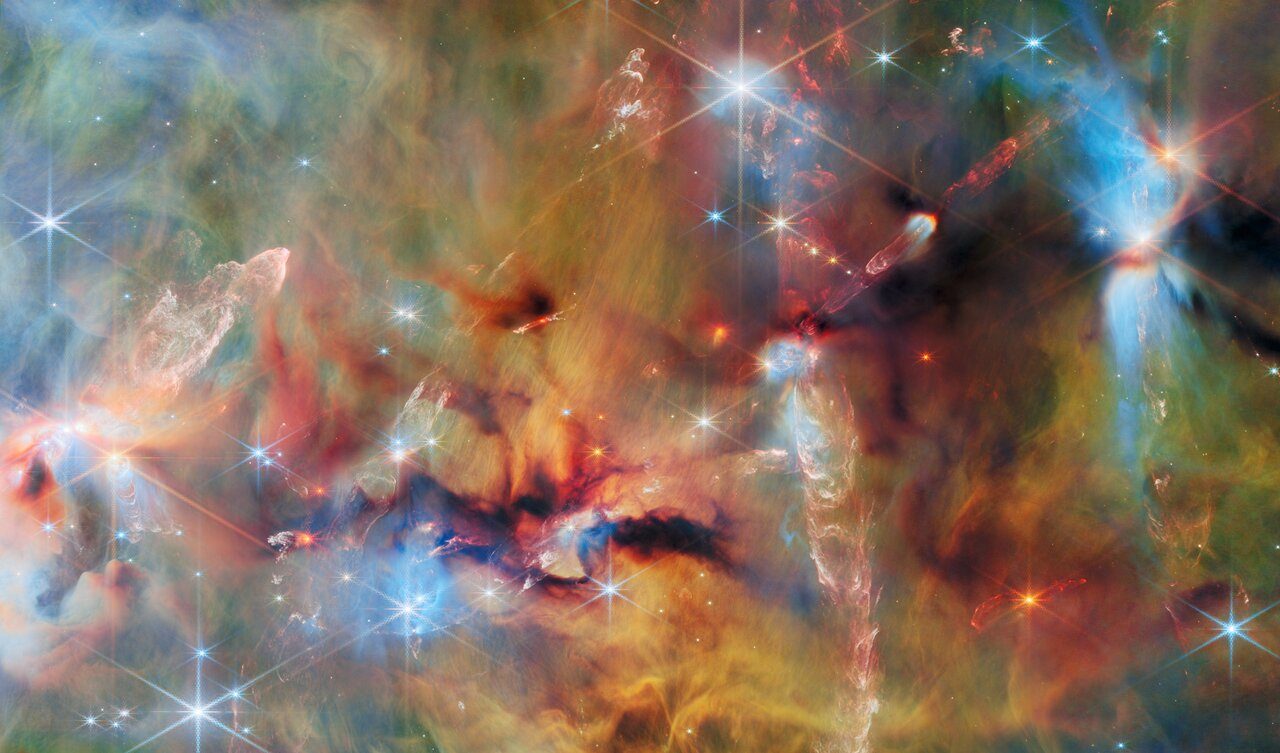
Webb’s infrared view of NGC 7129 reveals stars at different stages of development, with jets and winds helping to shape the gas around them.
| Active satellites | 16,697 |
| Catalogued objects | 32,122 |
| Starlink active | 9,814 |
Young stars are reshaping their birthplace in the James Webb Space Telescope’s infrared image of NGC 7129. The scene brings together stars at different stages of formation, offering a way to investigate how stellar nurseries evolve rather than treating star birth as a single event.
On the left, stars within gold-coloured gas are typically more mature than those in the red region on the right. Jets and winds probably help give the red gas its filamentary appearance: the threads are clues to how emerging stars disturb their surroundings.
Gravity builds; young stars push back
Star formation begins when gravity draws together large quantities of gas. As stars develop, their jets and winds can alter the surrounding material; some stars eventually explode, adding another source of disruption.
Dust complicates the view. It can form in cool stellar atmospheres and, once dispersed, obscure visible light. Infrared observations (observations at wavelengths longer than visible red light) help astronomers investigate dusty regions, although the displayed colours should not be read as an ordinary naked-eye view.
Comparing the younger and more mature populations in NGC 7129 helps researchers explore which processes matter most at different stages. The image is therefore both a portrait of star formation and evidence of the forces that complicate it.
A space telescope in a busier space age
Observing from space belongs to a much broader story of scientific and commercial activity beyond Earth. Orbital Radar tracking data lists 16,697 active satellites in orbit as of 16 November 2026.
Orbital Radar’s live catalogue contains 32,122 objects, including debris, as of 16 November 2026. For readers exploring that operational environment alongside the science, the Orbital Radar space situational awareness toolkit explains the tracking side of an increasingly populated orbital environment.
Frequently Asked Questions
What does Webb’s image of NGC 7129 show?
What causes the red filaments in NGC 7129?
Cite this article
Pick a style, then copy it or download it for your reference manager.Orbital Radar. (2026, November 16). NGC 7129: Webb Reveals Young Stars Sculpting Their Nursery. Retrieved November 16, 2026, from https://orbitalradar.com/blog/cosmic-gallery-2026-11-16
“NGC 7129: Webb Reveals Young Stars Sculpting Their Nursery.” Orbital Radar, 16 Nov. 2026, orbitalradar.com/blog/cosmic-gallery-2026-11-16. Accessed 16 Nov. 2026.
Orbital Radar (2026) NGC 7129: Webb Reveals Young Stars Sculpting Their Nursery. Available at: https://orbitalradar.com/blog/cosmic-gallery-2026-11-16 (Accessed: 16 November 2026).
Orbital Radar. “NGC 7129: Webb Reveals Young Stars Sculpting Their Nursery.” Last modified November 16, 2026. https://orbitalradar.com/blog/cosmic-gallery-2026-11-16.
@misc{orbitalradar_blog_cosmic_gallery_2026_11_16,
  author       = {{Orbital Radar}},
  title        = {NGC 7129: Webb Reveals Young Stars Sculpting Their Nursery},
  year         = {2026},
  month        = nov,
  howpublished = {\url{https://orbitalradar.com/blog/cosmic-gallery-2026-11-16}},
  url          = {https://orbitalradar.com/blog/cosmic-gallery-2026-11-16},
  urldate      = {2026-11-16},
  note         = {Accessed 2026-11-16}
}
TY - ELEC AU - Orbital Radar, TI - NGC 7129: Webb Reveals Young Stars Sculpting Their Nursery PY - 2026 DA - 2026/11/16 PB - Orbital Radar UR - https://orbitalradar.com/blog/cosmic-gallery-2026-11-16 Y2 - 2026/11/16 LA - en ER -
Live figures change, so keep the date you accessed the page. How to cite Orbital Radar