Dwarf stars in a glittering sky: Webb probes Westerlund 2
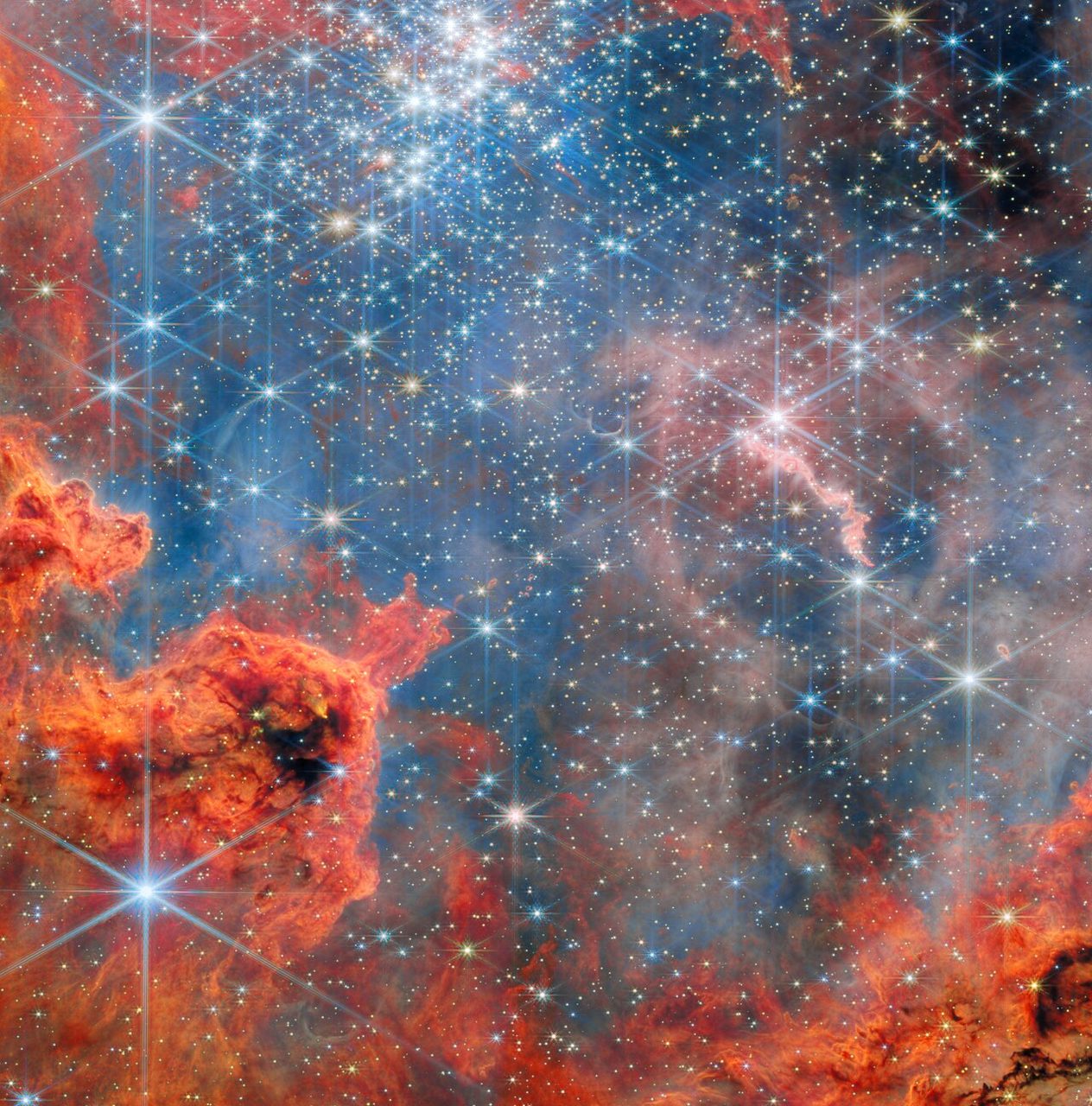
Webb’s infrared view of Westerlund 2 reveals sculpted clouds and faint brown dwarfs, offering a closer look at how stars and potential planetary systems develop.
| Active satellites | 16,712 |
| Catalogued objects | 32,174 |
| Starlink active | 9,807 |
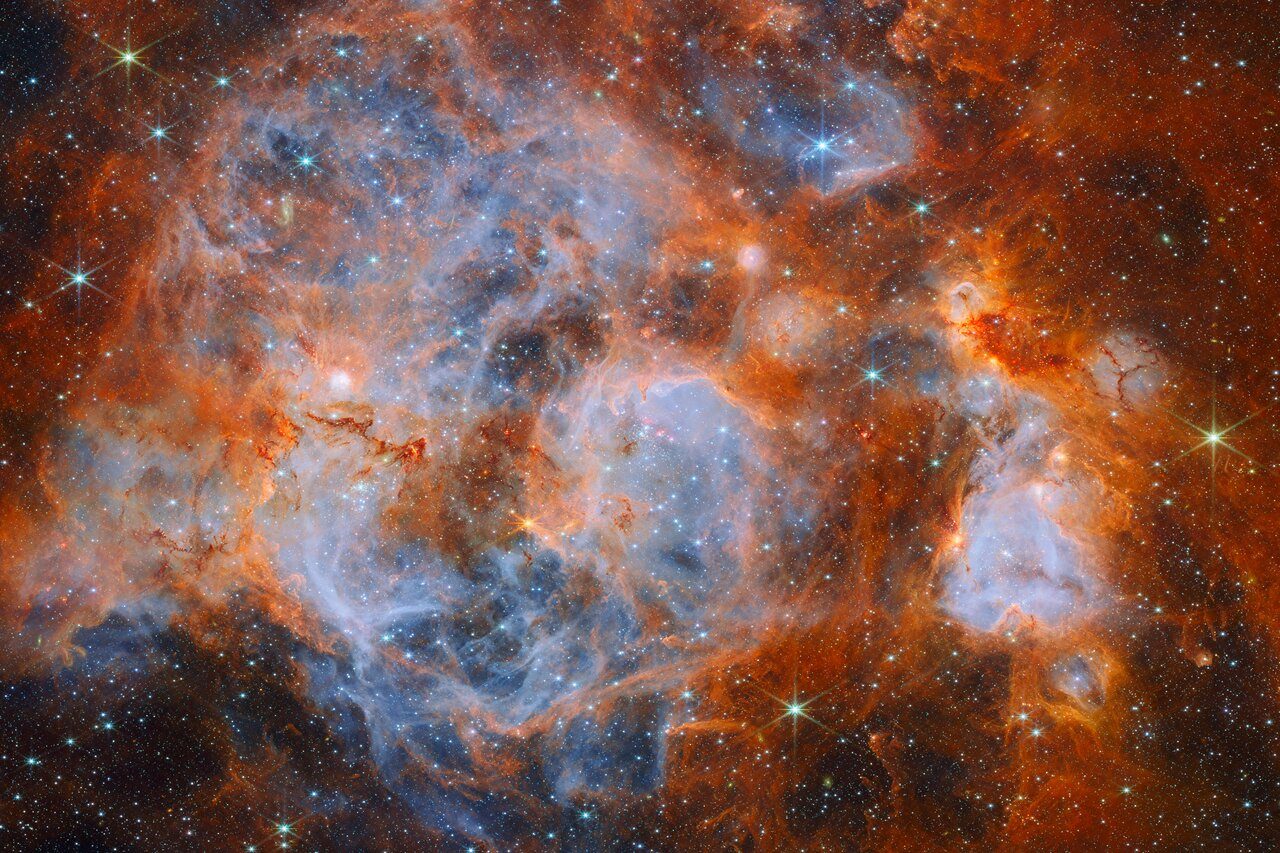
Webb’s view of Westerlund 2 reveals brown dwarfs with masses as low as about 10 times Jupiter’s within a crowded stellar nursery. Located 20,000 light-years away in the constellation Carina, the cluster sits inside the star-forming region Gum 29. Its young, massive stars gather near the top of the image, above red and orange clouds sculpted by their intense radiation.
The image combines observations from Webb’s Near-Infrared Camera (NIRCam) and Mid-Infrared Instrument (MIRI), which detect light beyond human vision. Pale pink and blue wisps trace thinner material between denser clouds, while some emerging stars remain surrounded by their birth material. The sharp spikes around bright foreground stars come from Webb’s optics, rather than structures surrounding the stars themselves.
From faint dwarfs to planet-forming discs
Brown dwarfs are objects too low in mass to sustain the hydrogen fusion that powers ordinary stars. These observations reveal what the researchers describe as the cluster’s full brown-dwarf population, extending the census beyond its conspicuous massive stars. Webb’s programme 3523, part of the Extended Westerlund 1 and 2 Open Clusters Survey, is also helping astronomers identify several hundred stars with surrounding discs at different evolutionary stages, probing how potential planet-forming material develops in this energetic environment.
Space observatories provide a scientific perspective distinct from the much larger population of spacecraft serving Earth. Orbital Radar tracking data records 16,712 active satellites as of 19 November 2026. Of those, 9,807 are operational Starlink satellites as of 19 November 2026, according to Orbital Radar tracking data. For readers exploring the spacecraft behind orbital astronomy, Orbital Radar’s Satellite Library provides a starting point; the glowing clouds here, however, belong to a distant stellar nursery, not Earth’s orbital neighbourhood.
Frequently Asked Questions
Where is Westerlund 2?
What has Webb revealed about brown dwarfs in Westerlund 2?
Cite this article
Pick a style, then copy it or download it for your reference manager.Orbital Radar. (2026, November 19). Dwarf stars in a glittering sky: Webb probes Westerlund 2. Retrieved November 19, 2026, from https://orbitalradar.com/blog/cosmic-gallery-2026-11-19
“Dwarf stars in a glittering sky: Webb probes Westerlund 2.” Orbital Radar, 19 Nov. 2026, orbitalradar.com/blog/cosmic-gallery-2026-11-19. Accessed 19 Nov. 2026.
Orbital Radar (2026) Dwarf stars in a glittering sky: Webb probes Westerlund 2. Available at: https://orbitalradar.com/blog/cosmic-gallery-2026-11-19 (Accessed: 19 November 2026).
Orbital Radar. “Dwarf stars in a glittering sky: Webb probes Westerlund 2.” Last modified November 19, 2026. https://orbitalradar.com/blog/cosmic-gallery-2026-11-19.
@misc{orbitalradar_blog_cosmic_gallery_2026_11_19,
  author       = {{Orbital Radar}},
  title        = {Dwarf stars in a glittering sky: Webb probes Westerlund 2},
  year         = {2026},
  month        = nov,
  howpublished = {\url{https://orbitalradar.com/blog/cosmic-gallery-2026-11-19}},
  url          = {https://orbitalradar.com/blog/cosmic-gallery-2026-11-19},
  urldate      = {2026-11-19},
  note         = {Accessed 2026-11-19}
}
TY - ELEC AU - Orbital Radar, TI - Dwarf stars in a glittering sky: Webb probes Westerlund 2 PY - 2026 DA - 2026/11/19 PB - Orbital Radar UR - https://orbitalradar.com/blog/cosmic-gallery-2026-11-19 Y2 - 2026/11/19 LA - en ER -
Live figures change, so keep the date you accessed the page. How to cite Orbital Radar