24 million light-years away, a dance of dwarf galaxies
Webb reveals a bridge of gas and stars between two dwarf galaxies. Their gravitational encounter offers clues to how galaxies grew in the early Universe.
| Active satellites | 16,716 |
| Catalogued objects | 32,155 |
| Starlink active | 9,750 |
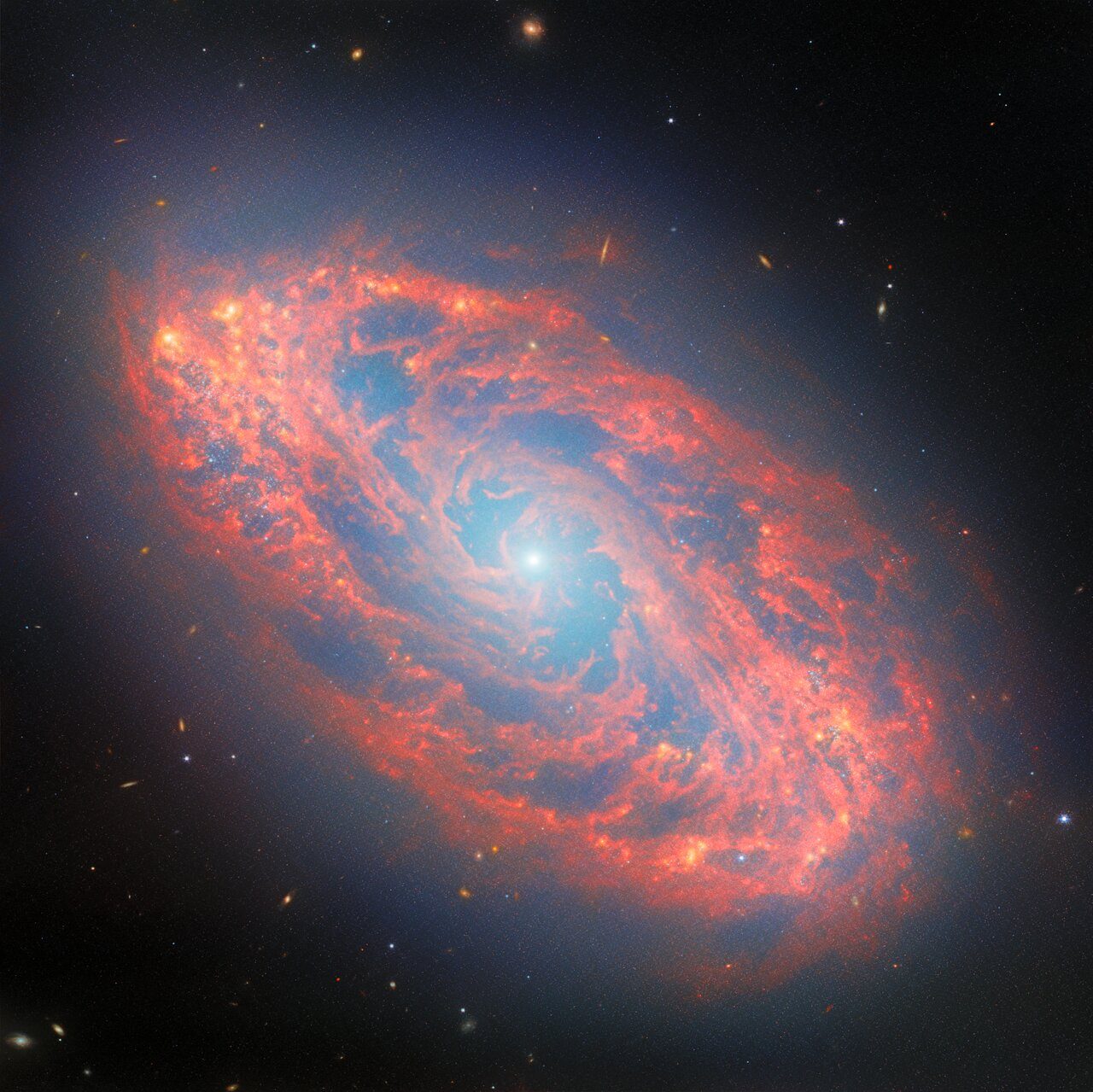
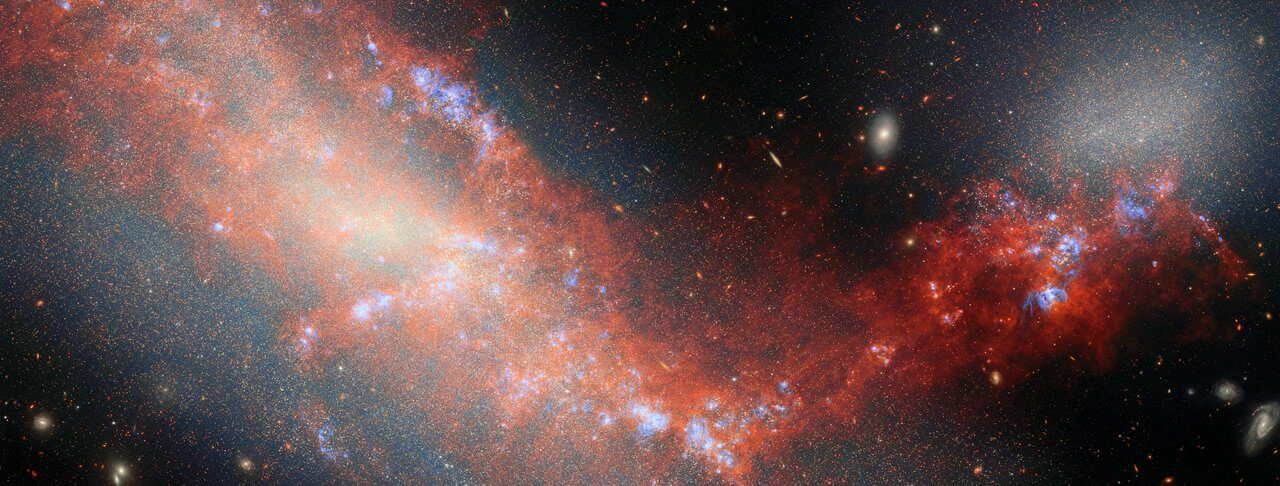
A bridge of gas and stars links NGC 4490 and NGC 4485, two dwarf galaxies about 24 million light-years away in Canes Venatici, the Hunting Dogs. Together they form Arp 269: a nearby laboratory for understanding how gravitational encounters reshape galaxies and redistribute the material from which stars form.
The larger galaxy, NGC 4490, occupies the left of this image, while its smaller companion sits towards the upper right. The view combines the James Webb Space Telescope’s Near-InfraRed Camera and Mid-InfraRed Instrument with a narrow-band Hubble filter, which selects a restricted range of wavelengths. Infrared observations help astronomers peer through obscuring dust.
By mapping young, middle-aged and old stars, researchers reconstructed part of the pair’s history. Roughly 200 million years ago, the galaxies passed close together; NGC 4490 drew gas from its companion, leaving a stream between them. The bridge is evidence of that encounter, rather than simply an apparent connection on the sky.
Gravity, from galaxies to Earth orbit
Webb observed the pair through the FEAST programme, which investigates star formation in nearby galaxies. Dwarf galaxies generally contain abundant gas, relatively few stars and low proportions of metals (elements heavier than helium). These properties make them useful comparisons for young galaxies in the early Universe, although nearby dwarfs are not exact replicas of their ancient counterparts.
Gravity also shapes the much smaller environment around Earth, where tracking focuses on individual spacecraft rather than stellar populations. Orbital Radar tracking data lists 16,716 active satellites as of 23 November 2026. Orbital Radar’s live catalogue contains 32,155 objects, including debris, as of 23 November 2026.
Readers can explore that local orbital environment through Orbital Radar’s space situational awareness toolkit. The scales are profoundly different, but both fields depend on understanding motion under gravity.
Frequently Asked Questions
How far away are NGC 4490 and NGC 4485?
What caused the bridge between NGC 4490 and NGC 4485?
Cite this article
Pick a style, then copy it or download it for your reference manager.Orbital Radar. (2026, November 23). 24 million light-years away, a dance of dwarf galaxies. Retrieved November 23, 2026, from https://orbitalradar.com/blog/cosmic-gallery-2026-11-23
“24 million light-years away, a dance of dwarf galaxies.” Orbital Radar, 23 Nov. 2026, orbitalradar.com/blog/cosmic-gallery-2026-11-23. Accessed 23 Nov. 2026.
Orbital Radar (2026) 24 million light-years away, a dance of dwarf galaxies. Available at: https://orbitalradar.com/blog/cosmic-gallery-2026-11-23 (Accessed: 23 November 2026).
Orbital Radar. “24 million light-years away, a dance of dwarf galaxies.” Last modified November 23, 2026. https://orbitalradar.com/blog/cosmic-gallery-2026-11-23.
@misc{orbitalradar_blog_cosmic_gallery_2026_11_23,
  author       = {{Orbital Radar}},
  title        = {24 million light-years away, a dance of dwarf galaxies},
  year         = {2026},
  month        = nov,
  howpublished = {\url{https://orbitalradar.com/blog/cosmic-gallery-2026-11-23}},
  url          = {https://orbitalradar.com/blog/cosmic-gallery-2026-11-23},
  urldate      = {2026-11-23},
  note         = {Accessed 2026-11-23}
}
TY - ELEC AU - Orbital Radar, TI - 24 million light-years away, a dance of dwarf galaxies PY - 2026 DA - 2026/11/23 PB - Orbital Radar UR - https://orbitalradar.com/blog/cosmic-gallery-2026-11-23 Y2 - 2026/11/23 LA - en ER -
Live figures change, so keep the date you accessed the page. How to cite Orbital Radar