A giant made of many: ALMA’s 66 dishes act as one eye
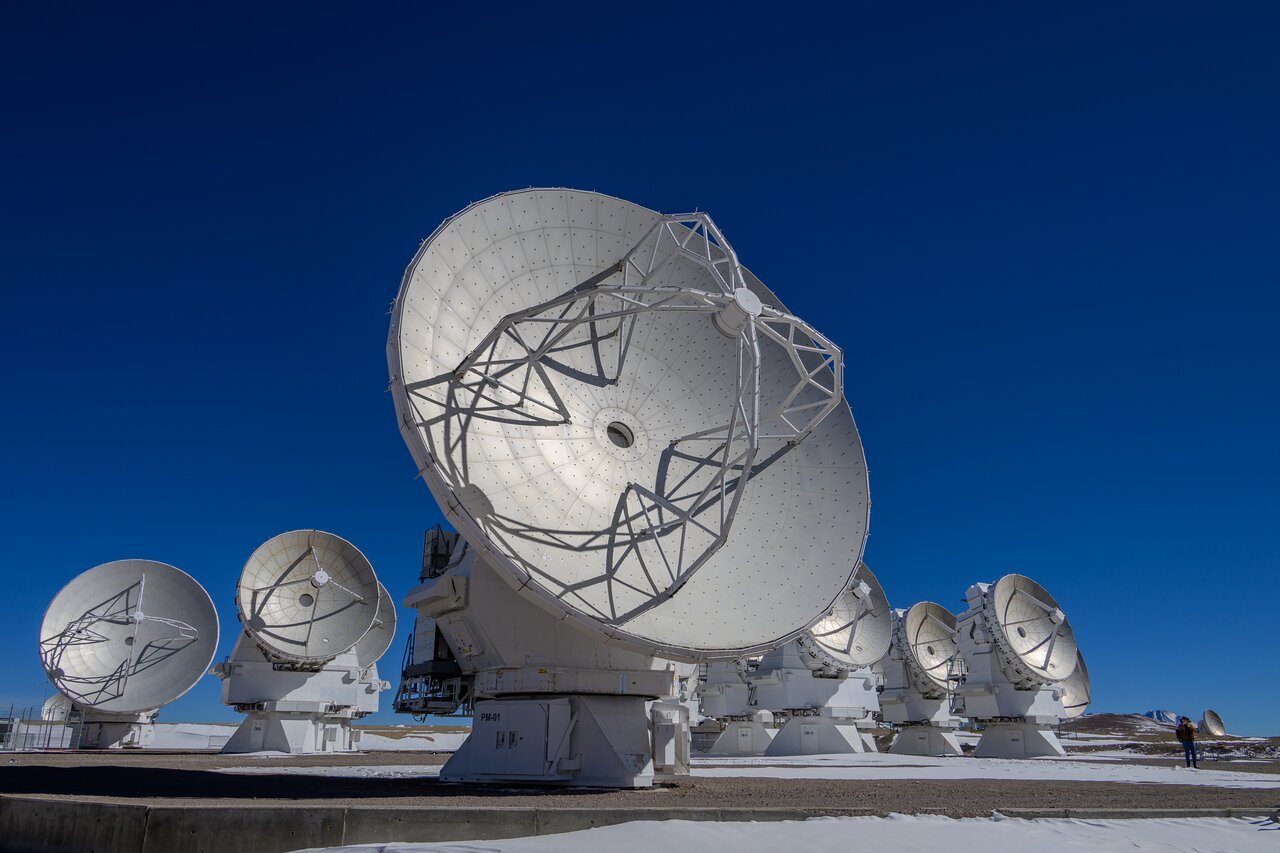
An apparently towering antenna is a trick of perspective. ALMA’s real power comes from combining its dishes to study cold gas, stellar nurseries and planet-forming discs.
| Active satellites | 16,710 |
| Catalogued objects | 32,133 |
| Starlink active | 9,778 |
ALMA’s 66 antennas work together as a telescope whose ability to distinguish fine detail depends on how widely its dishes are spread. In this ESO Picture of the Week, the nearest antenna appears to tower above a line of dishes receding beneath a clear blue sky. That apparent difference in size is perspective, not a hierarchy among the antennas.
The Atacama Large Millimeter/submillimeter Array, an international observatory in northern Chile in which ESO is a partner, combines the signals received by its antennas through interferometry (a technique that makes separated telescopes work together). Its antennas can be repositioned, with the greatest separations reaching 16 kilometres.
Closely grouped antennas are well suited to mapping broad cosmic structures; wider separations let astronomers distinguish finer details. The result is not a physically continuous giant dish, but an array whose arrangement helps determine what astronomers can resolve.
Reading the cold Universe from the ground
ALMA detects millimetre and submillimetre radiation rather than visible light. These wavelengths reveal cold gas and dust, including clouds where stars are born and discs where planets take shape. The photograph therefore shows the instruments, not the kind of cosmic light they collect.
Not every instrument exploring space needs to orbit Earth. Orbital Radar tracking data records 16,710 active satellites in Earth orbit in November 2026. Orbital Radar tracking data records 9,778 operational Starlink satellites in November 2026.
Those spacecraft represent a different use of the sky from ALMA’s ground-based observations. Orbital Radar’s space situational awareness hub follows the orbital environment, while its glossary explains spaceflight terminology. Here, the scientific achievement lies in making separated antennas function together, collecting clues to how stars and planets form.
Frequently Asked Questions
Why does one ALMA antenna look bigger than the others?
How does ALMA work as a single telescope?
Cite this article
Pick a style, then copy it or download it for your reference manager.Orbital Radar. (2026, November 21). A giant made of many: ALMA’s 66 dishes act as one eye. Retrieved November 21, 2026, from https://orbitalradar.com/blog/cosmic-gallery-2026-11-21
“A giant made of many: ALMA’s 66 dishes act as one eye.” Orbital Radar, 21 Nov. 2026, orbitalradar.com/blog/cosmic-gallery-2026-11-21. Accessed 21 Nov. 2026.
Orbital Radar (2026) A giant made of many: ALMA’s 66 dishes act as one eye. Available at: https://orbitalradar.com/blog/cosmic-gallery-2026-11-21 (Accessed: 21 November 2026).
Orbital Radar. “A giant made of many: ALMA’s 66 dishes act as one eye.” Last modified November 21, 2026. https://orbitalradar.com/blog/cosmic-gallery-2026-11-21.
@misc{orbitalradar_blog_cosmic_gallery_2026_11_21,
  author       = {{Orbital Radar}},
  title        = {A giant made of many: ALMA’s 66 dishes act as one eye},
  year         = {2026},
  month        = nov,
  howpublished = {\url{https://orbitalradar.com/blog/cosmic-gallery-2026-11-21}},
  url          = {https://orbitalradar.com/blog/cosmic-gallery-2026-11-21},
  urldate      = {2026-11-21},
  note         = {Accessed 2026-11-21}
}
TY - ELEC AU - Orbital Radar, TI - A giant made of many: ALMA’s 66 dishes act as one eye PY - 2026 DA - 2026/11/21 PB - Orbital Radar UR - https://orbitalradar.com/blog/cosmic-gallery-2026-11-21 Y2 - 2026/11/21 LA - en ER -
Live figures change, so keep the date you accessed the page. How to cite Orbital Radar