The Science Behind Supernumerary Rainbows

Discover the science of supernumerary rainbows, a rare atmospheric phenomenon that reveals the wave nature of light.
| Active satellites | 15,752 |
| Catalogued objects | 31,453 |
| Starlink active | 10,047 |
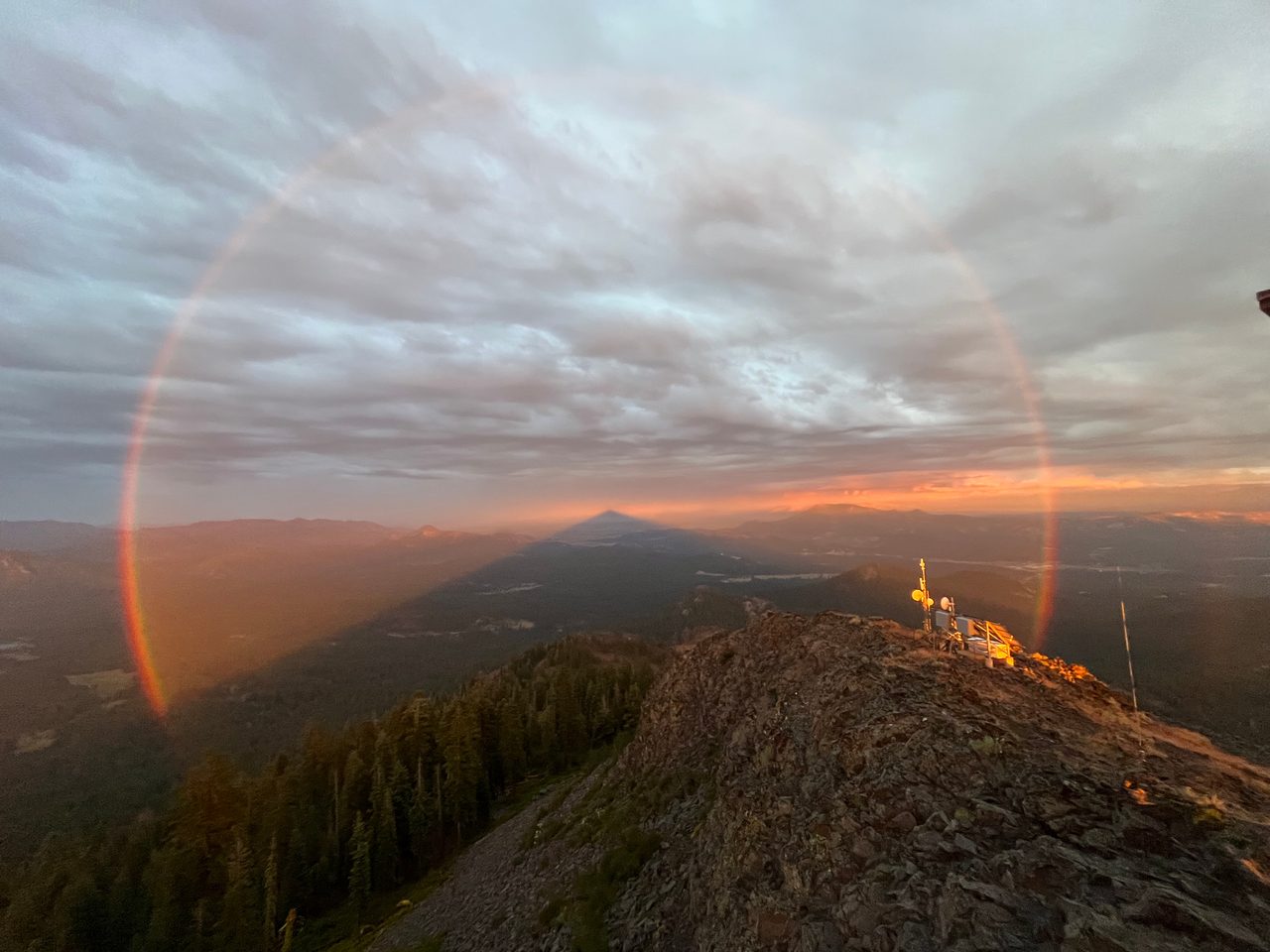
Today's image captures the rare beauty of supernumerary rainbows, observed after Hurricane Florence in 2018. Unlike typical rainbows, these feature multiple, closely spaced arcs that result from specific atmospheric conditions. They form when sunlight interacts with uniformly sized water droplets, typically less than a millimetre across. This interaction causes interference patterns, akin to ripples on a pond, revealing the wave nature of light.
The existence of supernumerary rainbows provided early evidence of light's wave characteristics, a significant scientific insight in the early 19th century. The phenomenon occurs when sunlight not only reflects inside raindrops but also diffracts, creating additional arcs. This image beautifully illustrates these principles, showcasing nature's intricate interplay of physics and atmospheric dynamics.
Connecting to Broader Space Science
The study of light and its properties is fundamental to space science, influencing everything from telescope design to the analysis of distant stars. Understanding wave phenomena aids astronomers in interpreting the spectra of celestial bodies, revealing their composition and movement. The principles behind supernumerary rainbows are reflected in the tools used to study exoplanets and cosmic phenomena.
For those interested in observing celestial events, the Eclipse Tracker on Orbital Radar provides detailed information on upcoming solar and lunar eclipses. These events, like rainbows, are governed by the same fundamental principles of light and shadow, offering further opportunities to appreciate the complexities of our universe.
Frequently Asked Questions
What causes supernumerary rainbows?
How do supernumerary rainbows differ from regular rainbows?
📎 Cite this article · data available
Orbital Radar Newsroom. (2026). The Science Behind Supernumerary Rainbows. Orbital Radar. https://orbitalradar.com/blog/cosmic-gallery-2026-10-04"The Science Behind Supernumerary Rainbows." Orbital Radar, 4 October 2026, https://orbitalradar.com/blog/cosmic-gallery-2026-10-04.@misc{orbitalradar_cosmic_gallery_2026_10_04,
title = {The Science Behind Supernumerary Rainbows},
author = {{Orbital Radar}},
year = {2026},
howpublished = {\url{https://orbitalradar.com/blog/cosmic-gallery-2026-10-04}}
}