Exploring Messier 2: A Stellar Time Capsule
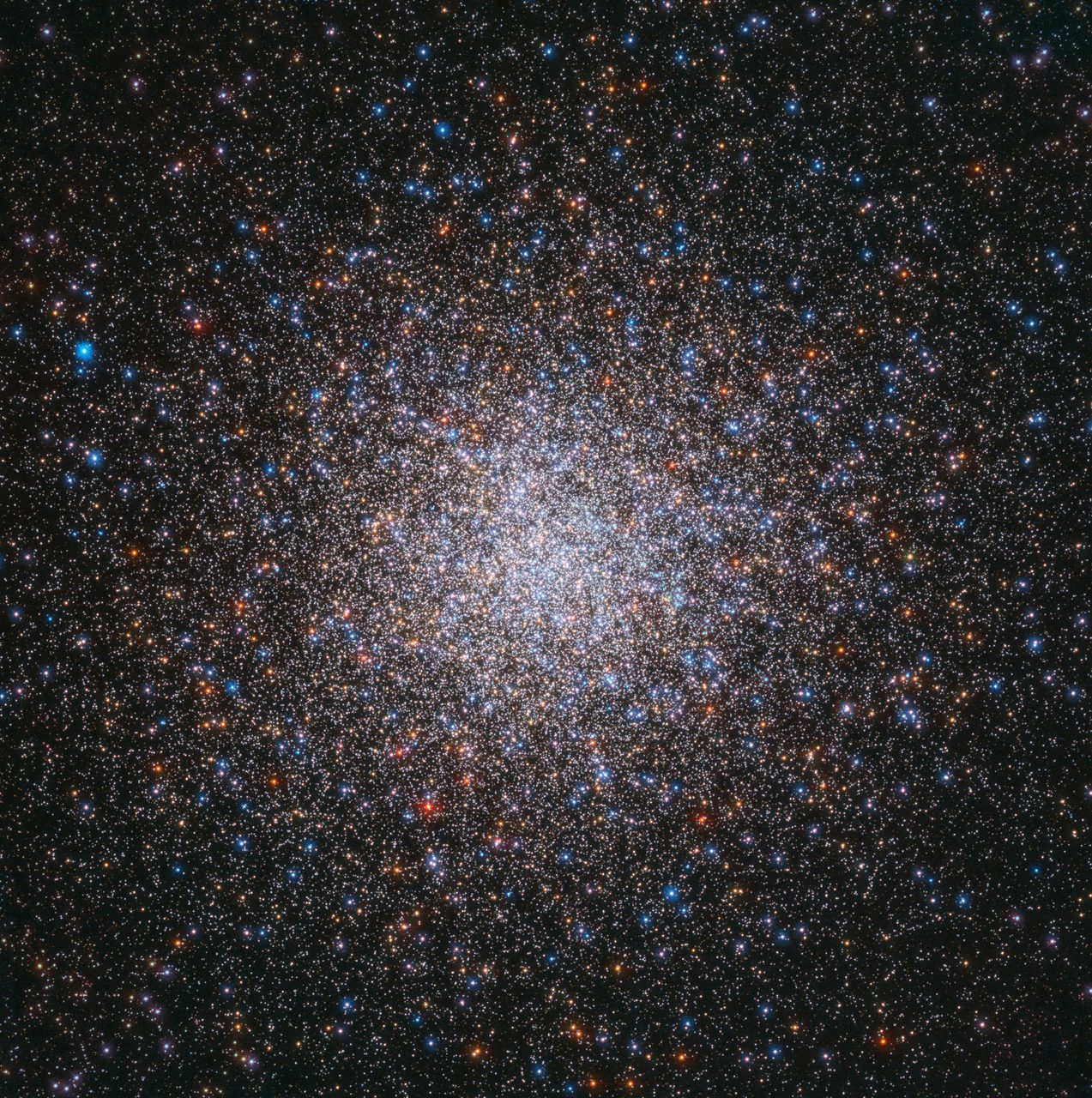
Messier 2, a vast globular cluster in the Milky Way, holds 150,000 stars within 175 light-years, revealing ancient cosmic history.
Messier 2, also catalogued as NGC 7089, is a remarkable globular star cluster located approximately 55,000 light-years from Earth in the constellation Aquarius. This celestial structure is one of the largest of its kind within the halo of the Milky Way, containing around 150,000 stars spread over a diameter of 175 light-years. The Hubble Space Telescope's detailed imagery reveals the cluster's densely packed core, offering a glimpse into a stellar population that dates back 13 billion years, nearly as old as the universe itself. Unlike the Crab Nebula, which Messier also catalogued, M2 was initially mistaken for a nebula without stars, highlighting the evolution of astronomical observations.
The significance of Messier 2 extends beyond its sheer size and age. Recent studies have revealed an extended stellar debris stream associated with the cluster, a testament to the gravitational tidal forces that have shaped its history. This discovery provides insights into the dynamic interactions between such clusters and the Milky Way, enriching our understanding of galactic evolution. As astronomers continue to explore these ancient formations, they uncover the complex gravitational dance that governs the cosmos.
For those interested in observing Messier 2, it can be located with a telescope in the constellation Aquarius. While not visible to the naked eye, amateur astronomers can enjoy a rewarding view of this ancient cluster. To track its position and plan your observation, consider using the Orbital Radar pass predictor, which offers precise details on when and where to look.
Frequently Asked Questions
What is Messier 2?
How old is Messier 2?
Cite this article
Pick a style, then copy it or download it for your reference manager.Orbital Radar. (2026, May 23). Exploring Messier 2: A Stellar Time Capsule. Retrieved November 19, 2026, from https://orbitalradar.com/blog/cosmic-gallery-2026-05-23
“Exploring Messier 2: A Stellar Time Capsule.” Orbital Radar, 23 May 2026, orbitalradar.com/blog/cosmic-gallery-2026-05-23. Accessed 19 Nov. 2026.
Orbital Radar (2026) Exploring Messier 2: A Stellar Time Capsule. Available at: https://orbitalradar.com/blog/cosmic-gallery-2026-05-23 (Accessed: 19 November 2026).
Orbital Radar. “Exploring Messier 2: A Stellar Time Capsule.” Last modified May 23, 2026. https://orbitalradar.com/blog/cosmic-gallery-2026-05-23.
@misc{orbitalradar_blog_cosmic_gallery_2026_05_23,
  author       = {{Orbital Radar}},
  title        = {Exploring Messier 2: A Stellar Time Capsule},
  year         = {2026},
  month        = may,
  howpublished = {\url{https://orbitalradar.com/blog/cosmic-gallery-2026-05-23}},
  url          = {https://orbitalradar.com/blog/cosmic-gallery-2026-05-23},
  urldate      = {2026-11-19},
  note         = {Accessed 2026-11-19}
}
TY - ELEC AU - Orbital Radar, TI - Exploring Messier 2: A Stellar Time Capsule PY - 2026 DA - 2026/05/23 PB - Orbital Radar UR - https://orbitalradar.com/blog/cosmic-gallery-2026-05-23 Y2 - 2026/11/19 LA - en ER -
Live figures change, so keep the date you accessed the page. How to cite Orbital Radar